What Prediction Markets Still Need: An Options Trader’s Wishlist

Term structures, scalar markets, rolling strategies, and portfolio analytics—the gaps prediction markets need to close and the roadmap for getting there.

I’ve spent more than a decade building analytical tools for options traders. Over the past year, I’ve turned that same lens on prediction markets. What I see is an asset class with extraordinary potential that’s moving fast but still has meaningful gaps to close before it can serve the full range of strategies that options markets support.

The good news: the exchanges are aware of most of these gaps, and there’s clear evidence that solutions are in development. The prediction market ecosystem is evolving at a pace that few new financial markets have matched, driven by strong institutional interest, growing regulatory clarity, and billions of dollars in investment.

Here’s what the market needs, and where I think it’s headed.

For background on prediction market mechanics: What Are Prediction Markets? A Guide for Investors. For how they compare to options: Binary Contracts vs. Puts and Calls. For why they’re not gambling: Are Prediction Markets Gambling? Why the Framing Is Backwards

Term Structures

If you trade options, term structures are part of your daily workflow. You can trade weekly, monthly, and quarterly expirations on the same underlying. The term structure itself contains information: the relationship between short-term and long-term implied volatility tells you something about market expectations for upcoming catalysts, seasonal patterns, and structural risk.

Prediction markets have some early term structure for recurring events. You can trade Fed rate contracts across multiple upcoming FOMC meetings simultaneously. But the depth and continuity lag far behind options. There’s no equivalent of the weekly/monthly/quarterly expiration series that options traders use for calendar spreads and term structure analysis. You get a handful of discrete event dates, not a rich multi-expiration curve to analyze.

Where it’s headed

This is a natural next step for exchanges competing for institutional volume. Kalshi and Polymarket are both expanding their contract offerings rapidly. Recurring economic events like monthly inflation readings, quarterly GDP reports, and regular Fed meetings are obvious candidates for rolling contract series. Some early versions of this are already visible in how both platforms handle sequential economic data releases. As the volume of available contracts grows, the ingredients for meaningful term structures will fall into place.

Scalar Markets: Beyond Binary

Today’s prediction markets are almost exclusively binary: will this happen, yes or no? This is powerful for directional views on specific events, but it limits the expressiveness of the instrument compared to options, where the payoff varies with the magnitude of the underlying’s move.

This will change. Both Kalshi and Polymarket have built support for scalar markets into their exchange architecture. Scalar markets ask “what will the value be?” rather than “will this happen?” and allow contracts across a continuous range of outcomes. A scalar prediction market on the S&P 500’s year-end level would create a probability distribution across outcome ranges. It would look remarkably like an options chain, but with direct, transparent probability pricing instead of implied volatility calculations.

Scalar market types already appear in exchange APIs, signaling clear directional intent even if the timeline for full deployment remains uncertain. Given the pace of development at both major exchanges and the clear demand from institutional participants, scalar markets are a “when” not an “if.” And when they arrive, they fundamentally expand what’s possible—bringing prediction markets much closer to the expressiveness that options traders need.

For how binary payoffs currently compare to options payoffs: Binary Contracts vs. Puts and Calls

Rolling and Continuous Strategies

Many popular options strategies depend on continuous execution across multiple expirations. The “wheel” strategy, income-focused premium selling, and systematic rolling programs all require a continuous flow of expirations with adequate liquidity.

Prediction markets can’t fully support this today. The contract lifecycle is typically a single event with a single resolution.

Where it’s headed

As term structures develop, rolling mechanics should follow naturally. If monthly contracts exist on the same theme, the basic ingredients for rolling strategies are in place. Exchanges could even build explicit roll functionality that automatically transitions a position from one contract to the next, similar to how futures platforms handle contract rolling today.

For more on what works today for income-focused investors and what’s coming: Income Strategies in Prediction Markets: What Works Today and What’s Coming

Contract Granularity and Event Types

An options trader on a major stock can choose from hundreds or thousands of strike-expiration combinations. Prediction markets currently offer a fraction of this granularity.

The market has evolved beyond simple yes/no propositions into several structural varieties: single-outcome, multiple-outcome, categorical, range, cumulative, and spread events. Each type creates different analytical opportunities.

Cumulative Thresholds as a Bridge to Scalar

Cumulative markets deserve special attention because they’re the closest thing to an options strike chain available today. Contracts like “Fed funds rate above 3%”, “above 4%”, and “above 5%” on the same event create a de facto strike chain. You can build vertical spreads, sell the tails for iron condor-like structures, and construct defined-risk positions that feel familiar to options income traders. When these cumulative thresholds exist across multiple settlement dates, you get something approaching an expiration cycle.

Cumulative markets are a meaningful bridge between today’s binary landscape and the full scalar market future. They’re tradeable now, and they reward the kind of spread analysis that options traders already do.

For specific strategies using cumulative thresholds: Income Strategies in Prediction Markets: What Works Today and What’s Coming

Spread Events and Pair Trading

Spread markets, currently most common in sports, compare two outcomes directly: “Will Team A beat Team B by more than 7?” Conceptually, this is pair trading—a direct relative-value bet without needing to construct a long/short position in separate instruments.

The interesting possibility is extending spread markets beyond sports. A contract like “Will Stock X outperform Stock Y by more than 500bps this quarter?” would offer direct, transparent relative value without the complexity of constructing a long/short equity position. This is speculative, but the structural framework already exists and the extension to financial markets is natural.

Where it’s headed

Scalar markets will be the biggest driver of improved granularity. But even within the current framework, both Kalshi and Polymarket are steadily increasing the number of contracts and thresholds available per event. Each quarter brings noticeably more markets with finer-grained outcome ranges. The trajectory is toward the kind of contract richness that supports nuanced multi-leg positions.

Cross-Event Portfolio Analytics

Most prediction market platforms treat each market as an island. There’s no built-in framework for understanding how your positions relate to each other or whether you’re inadvertently concentrated in correlated outcomes.

For why portfolio-level thinking matters so much: The Case for Prediction Market Portfolio Theory

Where it’s headed

This is an area where third-party tools are leading the way. With Qwidgets for Prediction Markets, you can already model relative likelihoods of outcomes within an event and generate optimized position sizing using approaches like Kelly criterion. Cross-event portfolio analytics, including understanding correlation and constructing diversified portfolios across multiple events, is the natural next frontier and part of the Qwidgets roadmap. We envision the platform evolving into the single place investors go to analyze, monitor, and trade predictions, equities, options, crypto, and more with robust support for cross-portfolio and cross-asset metrics and analytics.

The Underlying Asset Question

Options derive their value from an underlying asset you can separately own and trade. Prediction market contracts have no separately tradeable underlying. This is structural rather than a maturity issue.

But this isn’t necessarily a limitation. It’s a different design. Prediction markets give you direct exposure to the event itself, without the noise of a proxy instrument. The strategic framework is different: it centers on relative value between correlated contracts, portfolio construction across independent events, and position sizing based on estimated edge.

Market Making and Liquidity

Liquid options markets depend on dedicated market makers who continuously post bids and offers. Prediction market market-making infrastructure is still developing.

Where it’s headed

This is one of the gaps closing fastest. Major trading firms including Susquehanna and DRW are building dedicated prediction market desks. Kalshi’s FIX protocol connectivity and margin trading are explicitly designed to attract institutional market makers. ICE invested $1.6 billion in Polymarket. The economic incentives are strong, and the infrastructure is being built at speed. As these participants enter, spreads will tighten, depth will increase, and execution quality will improve across the board.

The Big Picture

What strikes me most about prediction markets in 2026 is how much the trajectory resembles options markets fifteen years ago. The instruments are sound. The regulatory framework is solidifying. The exchange infrastructure is being built. And critically, the major exchanges and their institutional backers are investing heavily in exactly the features that sophisticated traders need.

A dedicated $35 million VC fund backed by both the Kalshi and Polymarket CEOs launched specifically to fund prediction market tools and infrastructure. The regulatory environment has shifted meaningfully, with the CFTC moving away from its earlier adversarial posture and federal policy appearing broadly supportive of prediction market development, even as state-level regulatory questions remain. Every week brings new contract types, new platform features, and new institutional entrants.

The gaps I’ve outlined here are real today, but most of them have visible paths to resolution. Scalar market types already appear in exchange APIs, signaling clear directional intent. Term structures will emerge as contract offerings expand. Institutional market making is arriving now. Portfolio analytics are being built by both exchange platforms and third-party tools.

The trajectory suggests prediction markets are heading toward becoming a serious, full-featured asset class—the open questions are about pace and form, not direction. And the investors who start building expertise now, understanding both the current capabilities and the near-term roadmap, will have a significant advantage when the rest of the market catches up.

Start exploring prediction markets with analytical tools built for serious investors. Qwidgets for Prediction Markets is free at predictions.qwidgets.com.
The $100 Fed Rate Trade

A worked example comparing $100 invested via prediction markets vs. traditional securities for a Fed rate view. See why prediction markets deliver more direct event exposure.

Let’s make the prediction market thesis concrete.

Suppose you have a strong view that the Fed will hold rates steady at the next FOMC meeting. You have $100 to invest on this view, and you want to express it as efficiently as possible. Let’s walk through what that looks like using traditional securities versus a prediction market contract—and let the math make the argument.

The Traditional Securities Route

If you want to profit from a “Fed holds steady” view using traditional instruments, your options are all indirect.

Treasury Futures or Options

You could buy Treasury futures or options on futures that would benefit from a hold decision. But Treasury prices are driven by much more than just the next Fed meeting. They reflect the full term structure of interest rate expectations, inflation expectations, flight-to-quality flows, foreign central bank activity, and supply/demand dynamics in the bond market. A “Fed holds” outcome might not move Treasuries at all if the hold was already fully priced in, or the move might be overwhelmed by other factors.

With $100, you’re also limited in what you can access. Treasury futures have margin requirements that typically require thousands of dollars. Options on those futures have minimum premiums that make small positions impractical.

Bank Stocks or Rate-Sensitive Equities

You could buy or sell shares of interest rate-sensitive bank stocks. But bank stock prices are driven by earnings expectations, credit quality, regulatory developments, market sentiment, and a dozen other factors beyond the Fed’s next rate decision. Your “Fed holds” view might be correct while your bank stock position loses money because of an unrelated credit concern or earnings miss.

You’re also accepting equity market risk. If the broader market sells off for reasons unrelated to Fed policy, your position takes a hit regardless of what the Fed does.

Bond ETFs

You could construct a portfolio of bond ETFs calibrated to your rate expectations. This is more accessible with $100, but the same problem applies: bond ETF prices embed expectations about the entire rate path, not just the next meeting. And the move from a single “hold” decision, even if it surprises the market, will be modest relative to the noise in daily bond ETF returns.

The Common Problem

Every one of these approaches requires you to build a proxy—a portfolio of securities that should move in your direction if your rate view is correct. But each proxy carries exposure to factors you didn’t intend to bet on. You wanted to invest in a rate decision and ended up with exposure to credit risk, equity beta, duration risk, liquidity conditions, and market sentiment.

Even if your Fed call is right, you might not make money. And even if you do make money, it’s difficult to attribute the return to your rate view versus the other factors your proxy position was exposed to.

The Prediction Market Route

Now consider the prediction market alternative.

On Kalshi, you find a contract: “Will the Fed funds rate remain unchanged after the June FOMC meeting?” It’s trading at $0.82. The market is pricing an 82% probability that the Fed holds.

You believe the probability is higher. Your analysis of recent economic data, Fed communications, and the current macro environment puts the hold probability at 92%. You have an estimated 10-percentage-point edge.

You buy the contract at $0.82 with your $100. Here’s what happens:

If you’re right (Fed holds). Your contract settles at $1.00. You make $0.18 per contract on an $0.82 investment—a 22% return. On $100, that’s roughly $22 in profit.

If you’re wrong (Fed cuts or hikes). Your contract settles at $0.00. You lose your $100. But you knew this at entry. The risk was defined and transparent.

No unintended exposure. The return is driven entirely by one variable: did the Fed hold or didn’t it? No credit risk, no equity beta, no duration exposure, no liquidity conditions. Just the event and the probability.

A Note on Fees

This worked example focuses on the capital efficiency comparison and doesn’t account for transaction fees, which matter in practice. Prediction market exchanges charge fees that vary based on the contract price. On Kalshi, the fee structure follows a quadratic curve: fees are highest near $0.50 (where uncertainty is greatest) and taper toward the extremes. For a contract at $0.82, the fee is relatively modest, but it does reduce your net return.

The fee structure, along with Kalshi’s 3.5% APY on deposits and positions, significantly affects which strategies are practical and which aren’t. For the capital efficiency argument here, the core comparison holds—prediction markets still deliver far more direct event exposure per dollar than proxy instruments—but the full cost picture matters for strategy selection.

For a detailed breakdown of fees, carry yield, and their impact on strategy: Income Strategies in Prediction Markets: What Works Today and What’s Coming

The Capital Efficiency Comparison

Here’s where the math is striking.

With the traditional approach, your $100 buys a position that’s partially sensitive to the Fed decision and partially sensitive to everything else. Even if your Fed call is right, the return attributable to that call might be a fraction of the total position’s movement. You might make 2-5% on a correct Fed call—if the other factors cooperate.

With the prediction market contract, your $100 is entirely allocated to the event you have a view on. If you’re right, the return is 22%. If you’re wrong, you lose the capital. The risk/reward is concentrated on exactly the view you wanted to express.

This is what “direct event exposure” means in practice. It’s not a theoretical advantage—it’s a concrete capital efficiency gain. Dollar for dollar, a prediction market contract gives you more exposure to the specific event you’re trading than any traditional proxy construction.

The Information You Can Extract

The prediction market price also gives you something the traditional instruments don’t: a clean read on the market’s consensus probability.

When you look at Treasury yields or bank stock prices, you can infer the market’s rate expectations, but the signal is noisy. How much of the current 10-year yield reflects Fed expectations versus term premium versus inflation expectations versus supply dynamics? Reasonable analysts disagree.

A prediction market contract at $0.82 tells you the market’s Fed hold probability is 82%. Full stop. No decomposition required. No competing interpretations of what the price “really” reflects. This clarity is valuable not just for trading prediction markets but for informing your analysis across all your positions.

The transparency of prediction market pricing creates opportunities across your whole portfolio. See: What Options Greeks Can Teach Us About Prediction Markets

When the Traditional Route Still Wins

This isn’t a blanket argument that prediction markets are better than traditional instruments. They’re better for this specific use case: expressing a directional view on a discrete event as capital-efficiently as possible.

Traditional instruments are better when:

  • You want variable payoffs (a massive move pays more than a small move)
  • You need hedging capability (protecting a broader portfolio)
  • You want to express views on magnitude, not just direction
  • You need leverage beyond the binary payout structure
  • You’re trading assets where the underlying is continuously tradeable

For a full comparison of when each instrument is optimal: Binary Contracts vs. Puts and Calls

The key insight is that they’re complementary tools, and the smart investor uses each one where it’s most efficient. For discrete event views with defined outcomes, prediction markets are hard to beat.

Try It Yourself

The best way to understand the capital efficiency argument is to experience it. Find a market on Kalshi or Polymarket where you have a view. Compare what it would take to express that same view using traditional securities. Calculate the capital required, the unintended exposure, and the clarity of the expected return.

The comparison tends to make the case on its own.

Compare prediction market pricing across Kalshi and Polymarket in a single view. Qwidgets for Prediction Markets is free at predictions.qwidgets.com.
What Are Prediction Markets? A Guide for Investors

Learn how prediction markets work, where to trade them, and why they matter for investors. Covers Kalshi, Polymarket, contract mechanics, and getting started.

Prediction markets are having a moment. Kalshi, the leading U.S. prediction market exchange, recently raised $1 billion at a $22 billion valuation. Polymarket processes over $20 billion in monthly trading volume. CNBC and CNN have signed deals to broadcast prediction market data alongside traditional stock tickers. And the regulatory environment has shifted meaningfully, with the CFTC moving away from its earlier adversarial posture and federal policy appearing broadly supportive of prediction market development.

If you’ve been hearing about prediction markets but haven’t taken a serious look, this is your starting point. Here’s what they are, how they work, and why they matter for investors.

The Basic Mechanics

A prediction market is an exchange where you trade contracts on the outcomes of real-world events. Will the Fed cut interest rates at the next meeting? Will a specific bill pass Congress? Will inflation be above or below 3% next quarter?

Each contract trades between $0.00 and $1.00. If the event happens, the contract settles at $1.00. If it doesn’t, it settles at $0.00. The current trading price represents the market’s collective estimate of the probability that the event will occur.

If a contract is trading at $0.65, the market is pricing in a 65% probability. You can buy the contract at $0.65 and collect $1.00 if you’re right, or lose your $0.65 if you’re wrong. You can also sell the contract—effectively taking the other side—at whatever price the market offers.

Every contract has a Yes and a No side, and the prices always sum to $1.00. Buying Yes at $0.75 is economically identical to selling No at $0.25. If you trade options, this will feel familiar: it’s the same relationship as being long a call and short a put at the same strike. While each exchange has its own way of presenting and custodying positions, the user experience across the board simplifies to buying and selling Yes or No contracts.

That’s the entire structure. No complex derivatives math, no strike prices, no expiration chains. One event, one price, one outcome.

Are they options? Absolutely. They’re binary options. Or, if you’re trying to outrun the negative connotations of that term, you might call them “outcome-related options” (OROs).

If you trade options, the structural parallels run deep. See our companion piece: Binary Contracts vs. Puts and Calls

Why the Price Is the Probability

The elegant thing about prediction markets is that the price is doing double duty. A contract trading at $0.72 is simultaneously telling you two things: the cost to buy the contract is 72 cents, and the market’s implied probability of the event occurring is 72%.

This makes prediction markets one of the most transparent instruments in finance. When you look at a stock price, you’re seeing the market’s assessment of a company’s future cash flows, discounted back to today, filtered through dozens of assumptions about growth rates, risk premiums, and macroeconomic conditions. When you look at a prediction market price, you’re reading a probability estimate. Full stop.

This transparency is why prediction markets have become newsworthy. During elections, financial crises, and major policy decisions, prediction market prices provide a real-time, money-backed consensus estimate of what’s going to happen. They have frequently outperformed polls, pundit predictions, and model-based forecasts, making them one of the more reliable forecasting tools available.

How Prediction Market Exchanges Work

Prediction market exchanges operate as peer-to-peer matching platforms, similar in structure to traditional exchanges like the CBOE or CME. When you buy a contract, you’re matched with another participant willing to sell at that price. The exchange facilitates the match and handles settlement. This is fundamentally different from offshore binary options brokers, where you’re trading against the house. On Kalshi and Polymarket, you’re trading against other market participants, and the exchange is a neutral intermediary.

Where the Action Is

Prediction markets trade on several exchanges. The two dominant platforms are Kalshi and Polymarket, each with a distinct approach.

Kalshi

Kalshi is the only CFTC-regulated prediction market exchange in the United States. It operates like a traditional exchange with an order book, supports FIX protocol for institutional traders, and has integrated with brokerages including Robinhood. You fund your account with U.S. dollars via bank transfer or debit card, and you buy and sell contracts denominated in cents. For investors coming from traditional finance, Kalshi offers the most familiar experience.

Polymarket

Polymarket is the largest prediction market by total volume. It’s built on blockchain infrastructure and settles in USDC, a stablecoin pegged to the U.S. dollar. Your positions are represented as tokens rather than contracts, but the trading experience is functionally identical. Holding a “Yes” token at $0.65 on Polymarket means the same thing as a “Yes” contract at $0.65 on Kalshi. Polymarket has the deepest liquidity for political and economic events and recently received CFTC approval for U.S. operations.

There are also smaller exchanges that specialize in specific domains. PredictIt, for example, focuses on U.S. political events and has a dedicated community of political forecasters. But for breadth and depth of markets, Kalshi and Polymarket are where most of the activity is.

Exchanges operating in the US comply with standard “know your customer” (KYC) rules, so the experience is what you’d experience with any US brokerage.

What Can You Trade?

The range of available markets has expanded dramatically. Today you can trade contracts on:

  • Federal Reserve policy: Rate decisions, inflation targets, employment data.
  • Elections and politics: Presidential, congressional, gubernatorial races, Supreme Court decisions.
  • Economic indicators: GDP growth, CPI readings, unemployment figures.
  • Geopolitical events: Trade agreements, diplomatic milestones, international policy decisions.
  • Regulatory outcomes: Agency rulings, legislation passage, regulatory approvals.
  • Non-finance events: Sports, entertainment, and just about anything else.

The breadth of available markets continues to grow as the exchanges compete for volume and institutional interest increases.

Markets are organized into different types of events depending on whether there are one or more markets for the topic, whether those markets are mutually exclusive, whether their outcomes accumulate based on lower strikes, etc.

Learn more about prediction event types: Binary Contracts vs. Puts and Calls. For how cumulative thresholds enable spread and condor-like strategies: Income Strategies in Prediction Markets: What Works Today and What’s Coming

Not Gambling—Something Different

If prediction markets sound like gambling, you’re not alone. It’s the most common first reaction. But the comparison misses something fundamental about what these instruments actually are and how they function in a portfolio.

We address this question head-on in: Are Prediction Markets Gambling? Why the Framing Is Backwards

Why Prediction Markets Matter for Investors

Beyond the trading opportunity itself, prediction markets provide something that didn’t previously exist: a direct, transparent way to express a view on a specific real-world event.

Consider the alternative. If you believe the Fed will hold rates steady at the next meeting, your traditional options are all indirect. You could trade Treasury futures, take positions in interest rate-sensitive bank stocks, or construct a bond ETF portfolio. Every one of these approaches carries exposure to factors beyond the rate decision itself: credit risk, equity market beta, duration, liquidity conditions, and a host of other factors. You wanted to invest in a rate view and ended up with a portfolio sensitive to everything else in the market. We largely built Quantcha around helping investors understand and manage the wide multitude of risks associated with option strategies expressing a narrow view.

A prediction market contract on the actual Fed decision strips away all of that noise. You buy the contract at its current price, and the potential return is transparent and immediate. For event-driven investing—which represents a significant and growing portion of market activity—this is a fundamentally more efficient instrument.

For a worked example with real numbers, see: The $100 Fed Rate Trade

An Evolving Market

Prediction markets today are powerful, but they’re also still maturing. The exchanges are actively building new capabilities. One of the most impactful evolutions in prediction markets will be the adoption of scalar markets that enable scaled payouts mapping to vertical call spread payouts. This will enable contracts across continuous outcome ranges, richer contract offerings across recurring economic themes, and institutional-grade infrastructure for professional traders.

For a deeper look at where the industry is headed: What Prediction Markets Still Need: An Options Trader’s Wishlist

The trajectory is clear, and the pace of development is accelerating. Understanding prediction markets now, while the market is still early and the analytical edge of sophisticated participants is at its greatest, is the smart play.

How to Get Started

If you’re ready to explore prediction markets, here’s a practical starting path.

Start by watching. Pick a few markets on Kalshi or Polymarket that relate to events you follow. Track Fed decisions, economic data releases, political outcomes. Watch how the contracts trade in the days and hours before resolution. You’ll quickly develop intuition for how these markets behave.

Make a small trade. You can buy your first Kalshi contract for less than a dollar. Place a trade on something you have a view on and observe how it feels. The mechanics are simple, but having real money at stake sharpens your attention.

Think across platforms. The same event can be priced differently on Kalshi and Polymarket because they have separate liquidity pools and user bases. Comparing prices across exchanges gives you a more complete picture of market sentiment. But don’t get too distracted by the hype around exchange arbitrage. If the markets are trading at a noticeably different price for any extended period, there is surely a good reason.

Use proper tools. The native platform interfaces are fine for placing simple trades, but if you want to compare markets across exchanges, track multiple positions, or analyze pricing in depth, purpose-built tools make a significant difference. Qwidgets for Prediction Markets aggregates data from Kalshi, Polymarket, and other exchanges into a single view, with integrated Kalshi trading and shareable analysis workspaces. And it’s free.

Try Qwidgets for Prediction Markets at predictions.qwidgets.com—free cross-platform data, integrated trading, and shareable workspaces for serious prediction market participants.

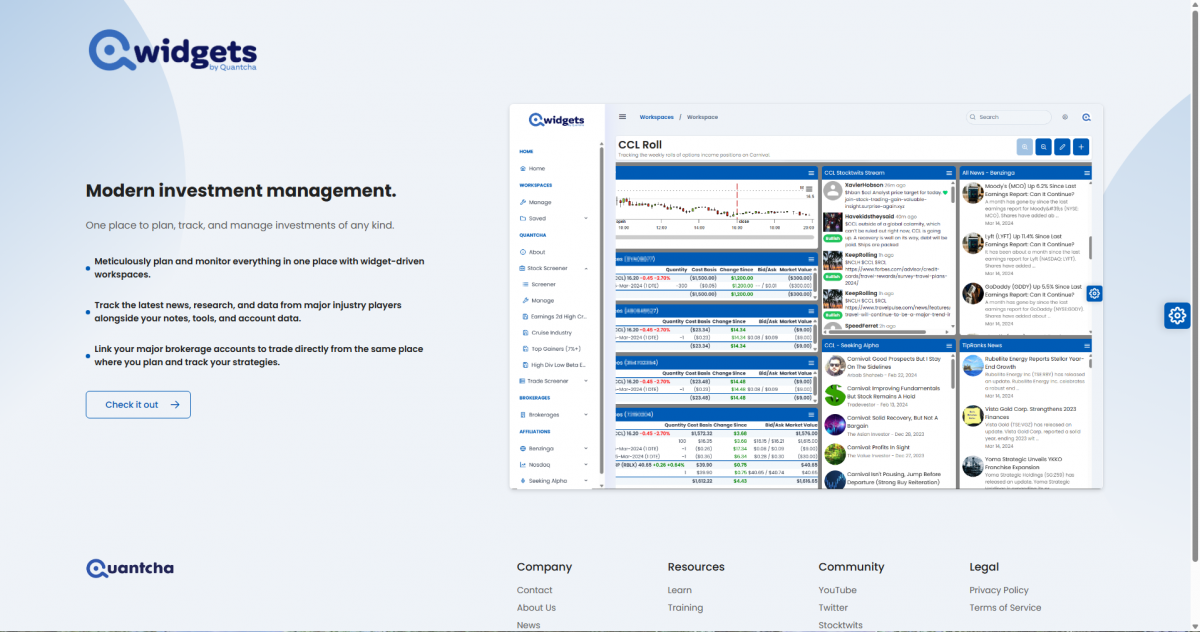
Introducing Qwidgets: The free place to plan, track, and manage your investments

We’ve been proud to deliver top-quality tools and services to the option investment community for the past decade. However, in that time we’ve received tons of feedback that the entire industry wasn’t properly serving its membership with the tools it needs to effectively organize their various strategies.

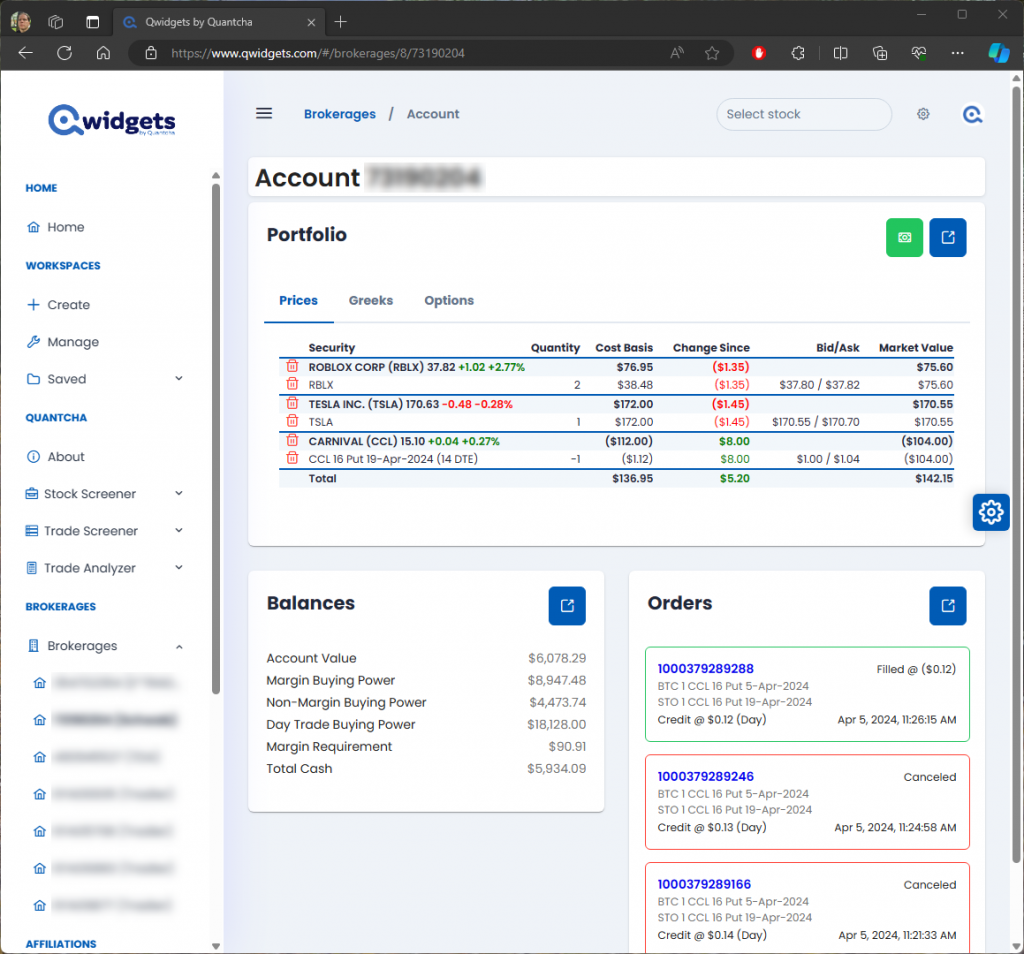
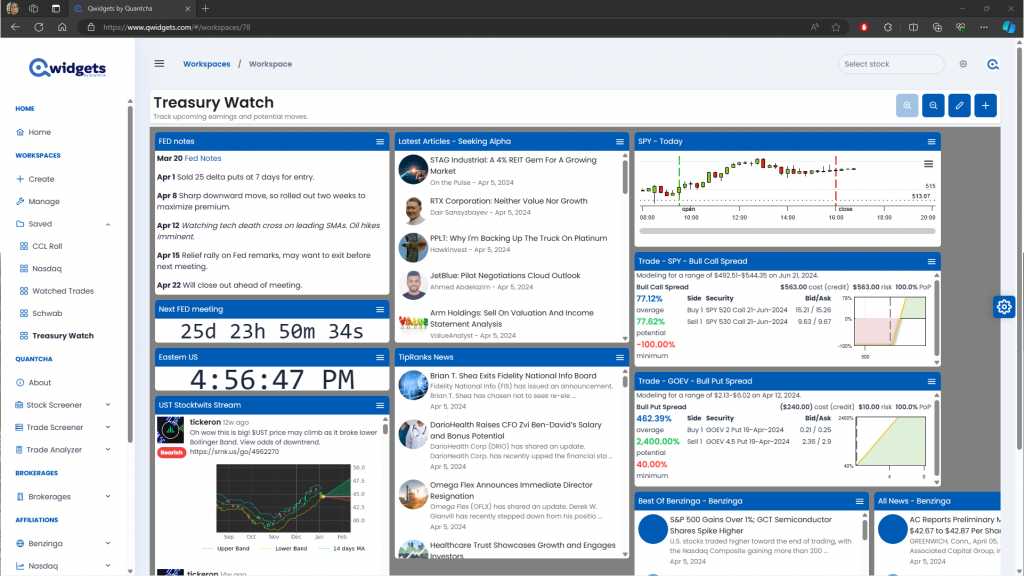
A workspace to monitor Fed moves

Around a year ago we set out on a journey to update Quantcha to provide tools to meet these needs. Our vision was to deliver a workspace-driven user experience where users would be able to precisely customize each workspace to fit their exact needs for the task at hand. This customization would come in the form of task-focused widgets designed to chart quotes, track trade ideas, manage orders, and so on. The scenarios were endless, so we knew it needed to be flexible.

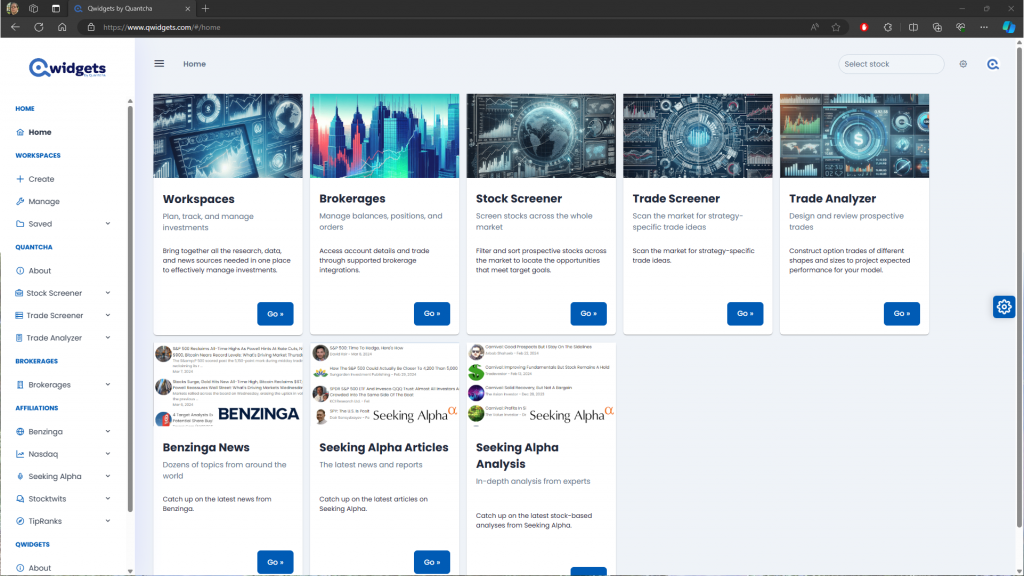
Qwidgets Home view

As we started showing our industry partners early demos of this new feature—which we were calling Quantcha Widgets—there was consistent feedback that it would be really helpful to a much broader audience than our traditional options investor customers. As a result, we made the decision to launch it as a separate service called Qwidgets and make it free for everyone.

Integrated brokerage support

We also knew that users relied on a lot of data and functionality beyond what we delivered. To meet those needs, we partnered with some of the best names in finance to integrate brokerage, news, analysis, social media, and more. We envisioned a platform where anyone could place and manage orders alongside the latest research and breaking developments.

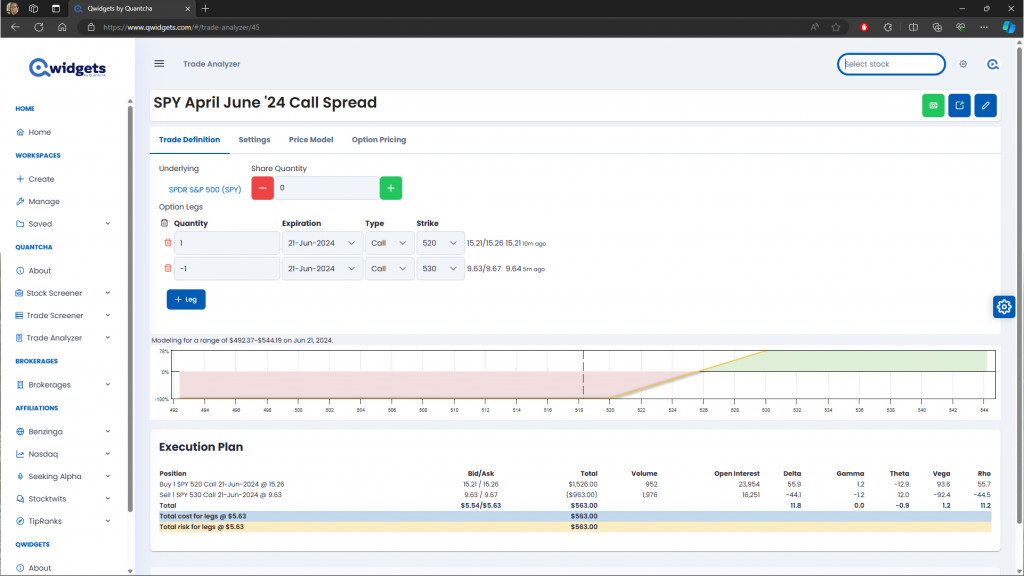
Integrated trade analyzer

To use Qwidgets you’ll need to create a new account that’s separate from your Quantcha account. However, you can then link your Quantcha account in order to enable some advanced options-focused features, such as pages and widgets for screeners and the trade analyzer. Over time we’ll be migrating all of our Quantcha functionality to Qwidgets so that subscribers can enjoy the full depth of our functionality on either platform.

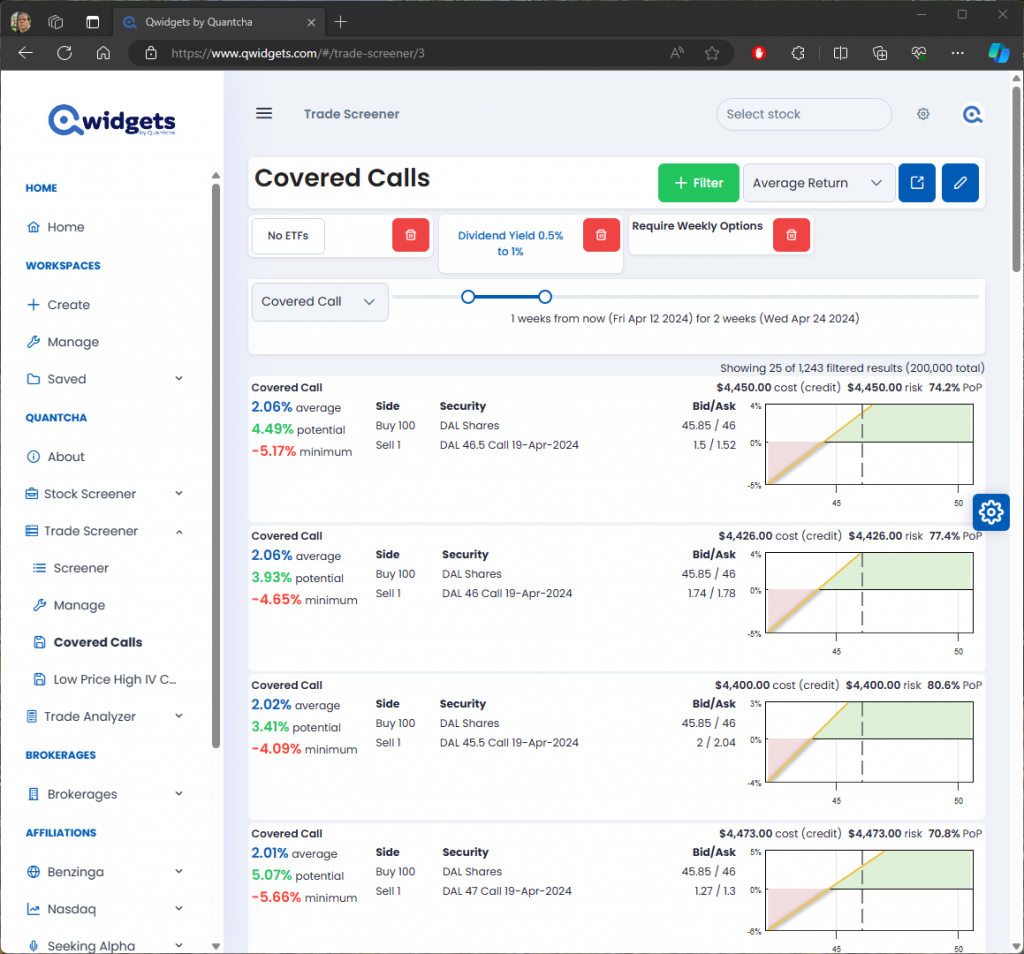
Trade screener powered by Quantcha

If you have feedback, please let us know at hello@quantcha.com. In the meantime, check out our launch video!

Qwidgets launch video

Announcing Quantcha’s Integration with Charles Schwab

We’re proud to announce that we have launched our integration with Charles Schwab. This enables Charles Schwab brokerage customers to manage their account positions and orders directly from Quantcha. Create and link your account today.

The Quantcha Options Suite complements Charles Schwab’s existing options platform with sophisticated options book management, detailed trade reporting, proactive alerts, and a wide variety of trade discovery and analysis tools.

At this time our Schwab integration relies on Quantcha’s 20m delayed data feed. When Schwab publishes their market data API we will update our integration implementation to use it.

Create and link your account today.

Announcing Quantcha’s New Free Trial Model

We’re excited to share a new way for investors to try out Quantcha Options Suite at no cost. Effective immediately, all users linked to a supported brokerage account will receive full subscription access for the first five days of each month (May 1-5, for example). This temporarily elevated access requires no additional steps beyond linking the brokerage account with their Quantcha account and includes the full functionality of a subscription.

Quantcha currently provides integration with major brokerages, including Charles Schwab’s TD Ameritrade, Morgan Stanley’s E*TRADE, and Tradier. To learn more about our brokerage integration, please see the documentation.

Quantcha’s Latest Research Report on Trading Earnings with Options Now Available

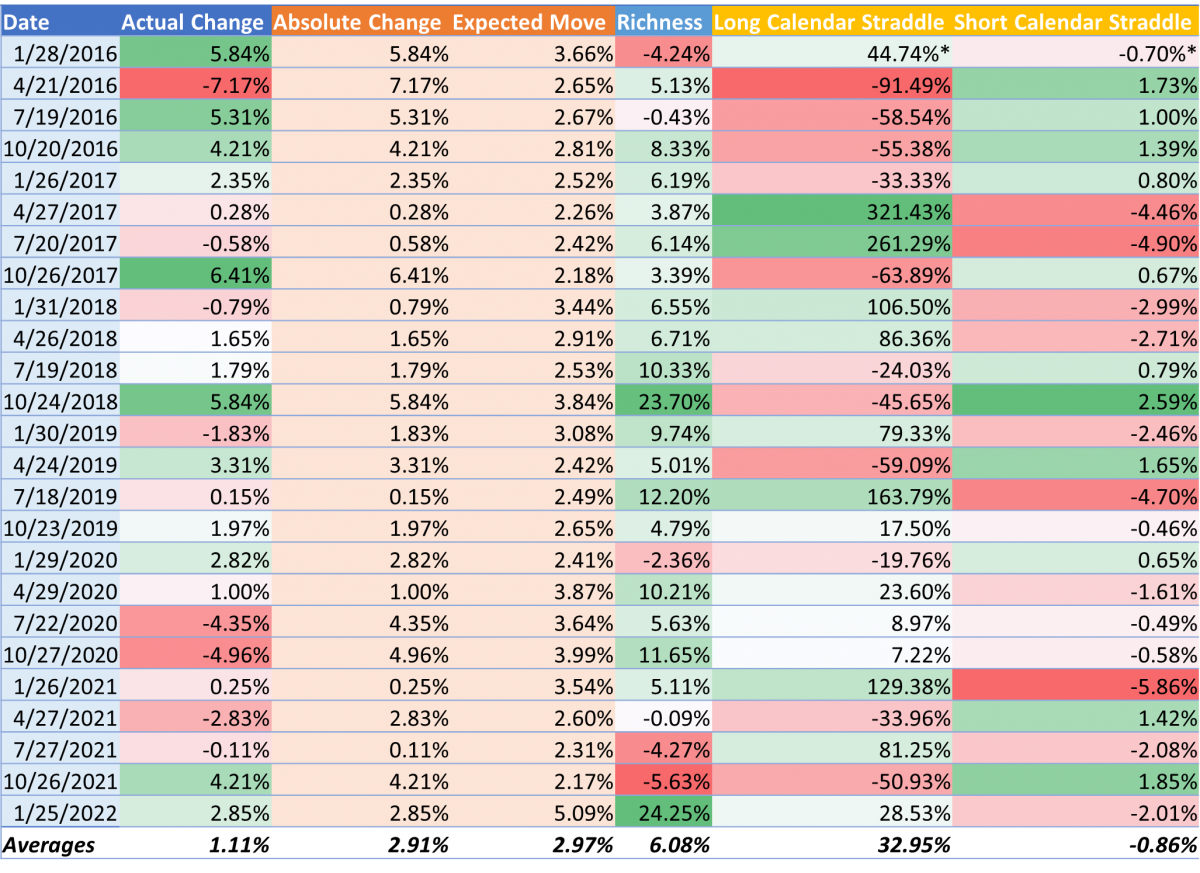
We’re proud to announce that our latest research report, An analysis of trading earnings releases using options, is now available. This report analyzes the behavior of options and implied volatility before and after earnings announcements.

The report focuses on answering common questions about trading earnings with options, including:

  • Why trade options around earnings?
  • How are earnings options priced?
  • What about trading earnings directionally with options?
  • How do we compare returns of long and short strategies?
  • How important is option liquidity?
  • What is implied volatility crush (IV crush)?
  • What is earnings IV crush?
  • How much does IV crush after earnings?
  • Can we predict the earnings IV crush?
  • Can we infer anything from the volatility surface?
  • Can we still lose by selling overpriced IV?
  • How can we hedge against directional moves?
  • How do calendar trades hedge out directional risk?
  • How can we employ calendar trades to capitalize on IV crush?
  • How does this analysis hold up across the broader market?

It also includes details on how anyone can gain special insights regarding trading options around earnings via option-centric data.

The report is also available as a PDF for download.

Quantcha’s Latest Research Report on Market Corrections Now Available

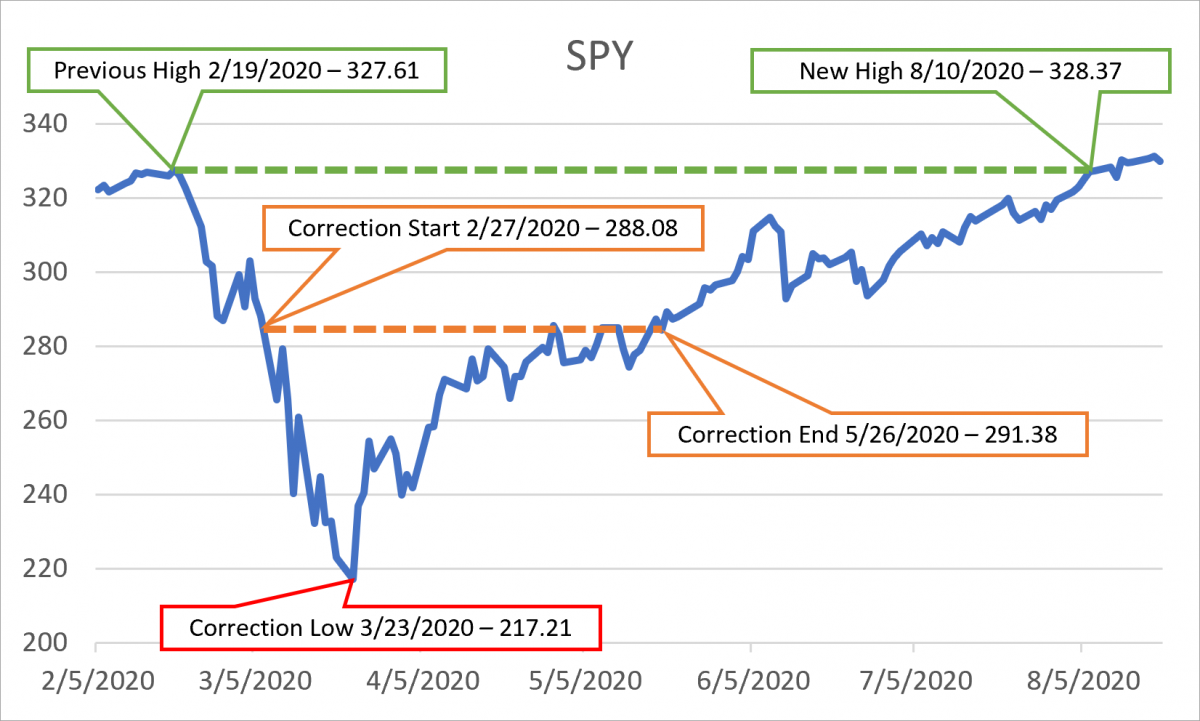
We’re proud to announce that our latest research report, What do we know about market corrections?, is now available. This report analyzes market correction cycles as indicated by a 10%+ drop in the S&P 500.

The report focuses on answering common questions about market corrections, including:

  • How often do corrections happen?
  • How long does it take to enter a correction from a high?
  • What can we expect once we enter a correction?
  • How does the market perform during a correction?
  • Is it worth trying to call a bottom?
  • How long does it take to recover from the bottom?
  • What happens after corrections?
  • What can we do with the data we have?
  • What happens if you invest at the start of a bull run?
  • How do we know when a correction is coming?
  • How do we know when a correction is easing?
  • What kind of returns can we expect from different correction milestones?
  • Is there an ideal strategy for correction investing?

It also includes details on how anyone can gain special insights regarding correction progress via option-centric data.

The report is also available as a PDF for download.

Announcing Quantcha’s Stress Tester

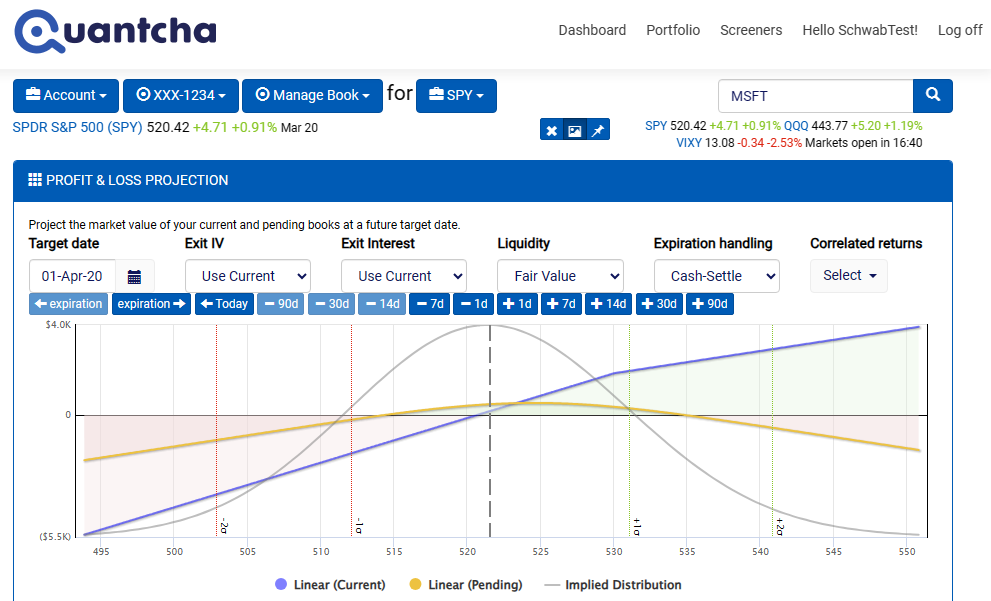
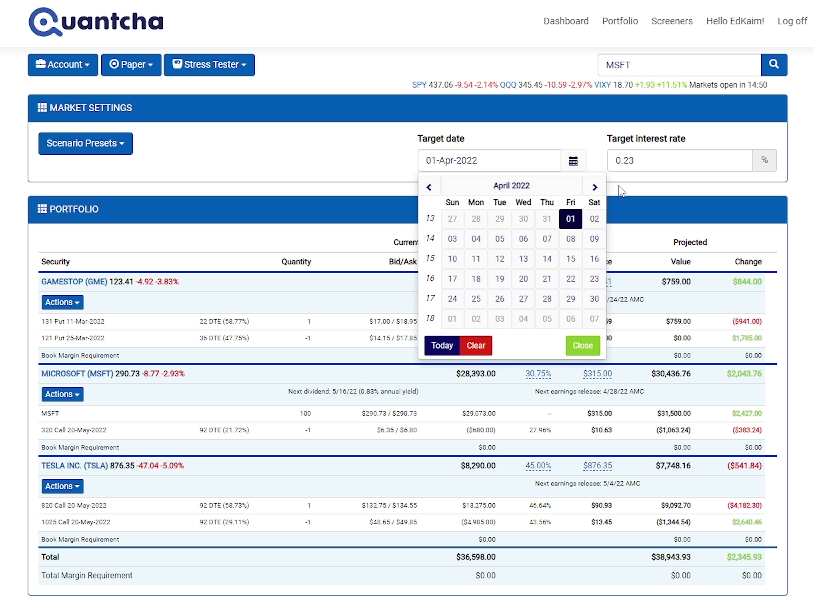
We’re proud to announce the launch of our new portfolio stress tester. It provides a straightforward experience for investors to project how their portfolios will handle arbitrary market conditions at a future date, including changes in interest rates, as well as underlying prices and volatilities.

The stress tester complements our powerful book manager to further equip investors with the tools they need to manage sophisticated option portfolios. Whereas the book manager provides superior in-depth analysis and experimentation with underlying-specific books, the stress tester offers breadth analysis for potential market scenarios.

Check out a video walkthrough of the stress tester on YouTube.

Learn more about stress testing option portfolios with Quantcha.

Announcing Quantcha’s support for Two-Factor Authentication

We’re proud to announce that Quantcha now requires two-factor authentication (2FA) for all accounts. When users log in, they must additionally enter a security code that has been sent to the email address associated with their account.

This step helps guard against the risk of an attacker guessing their credentials since they would also need access to the user’s email account in order to log in on their behalf. Further, the code emails provide early warning to users in the event someone else figures out their Quantcha credentials.

Quantcha’s 2FA requirement applies whether the account is secured with an email/username and password or a 3rd party login, such as Facebook or Twitter.