

It’s not great for the one trade options sellers had left.
Last week Kalshi’s clearinghouse asked the CFTC to approve margin on some event contracts. The take that traveled furthest, with a couple million views behind it, was that Kalshi wants to let its users gamble with borrowed money.
That isn’t what the filing proposes, at least not the way it was described. The misread spread because it was the more fun story.
Margin under Kalshi Klear’s proposed framework clears only through a futures commission merchant or a firm approved to clear for itself. The do-it-yourself route requires being an eligible contract participant, which for an individual means more than $10 million invested on a discretionary basis, and then getting approved as a clearing member. You won’t find margin in Kalshi’s own app, and contracts on sporting events are excluded outright. Whether a retail brokerage with its own FCM ever passes margin through to its customers is up to that brokerage, and none has said it will. If you were picturing sports bettors leveraging themselves into oblivion, you can relax.
It’s still relevant to retail traders in the markets that will be eligible, for a reason that has nothing to do with borrowed money. It lands on the one trade I thought options sellers still had.
Retail option premium sellers and prediction markets
For most of this year I’ve been trying to find a way for options traders to bring their playbook into prediction markets. In June I wrote that the bigger opportunity was “opening Kalshi’s markets to the equity options crowd,” while admitting their income strategies wouldn’t translate cleanly. In July I called the One Man Insurance Company “the most successful retail strategy.” Sell a put, collect the premium, roll it, and if you get assigned, write calls against the shares while you wait.
The search keeps hitting the same walls. There’s no volatility risk premium on a binary, so there’s nothing structural to sell. A binary settles at zero or one, so a losing trade can’t recover the way an assigned put can. And when I looked at an options layer built on top of prediction markets, I couldn’t find the patient, long-horizon capital it would need. “I’ve had a hard time finding these people and am starting to wonder if they’re ever going to emerge.” That was June. It’s still true.
That leaves one trade that looks like premium selling if you squint. Buy the heavy favorite, usually the No on something that almost certainly won’t happen (because nothing ever happens), and collect the last few cents as it rolls to a dollar. Repeat. I’ll call it the yield farm, because that’s how people describe it when they’re running it.
The yield farm already pays crumbs
To see what the farm actually pays, I pulled every open market on Kalshi this morning and kept the heavy favorites in finance and economics contracts. Those are the categories most likely to land on the margin side of the line. One contract per event, favorite side priced 90¢ or better, and a quote on both sides of the book.
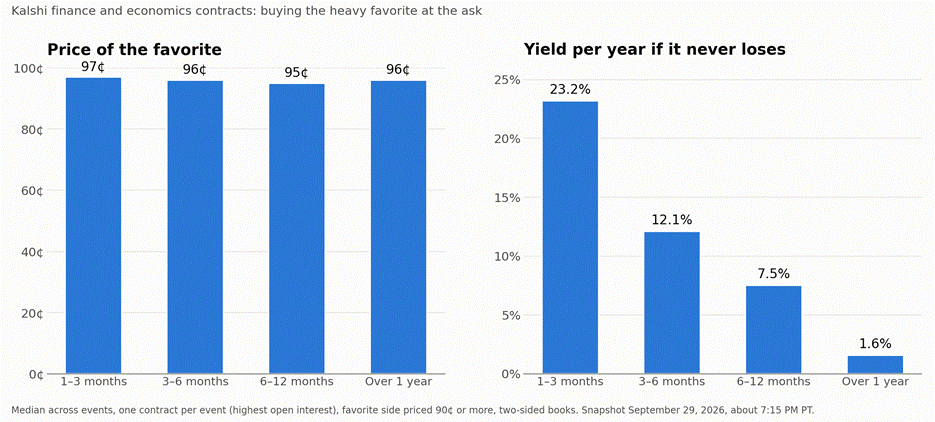
The left side is the whole story. A heavy favorite costs about 96¢ regardless of when it pays out. The market prices these contracts per contract, not per year, so the yield falls apart as the time horizon grows. On contracts more than a year out, the median favorite pays about 1.6% a year if it never loses, and more than three quarters of them pay under 4%. That’s the best case, before the chance you lose, and before whatever interest the venue pays on your balance.
A concrete one. No on the Fed cutting by more than 25 basis points at its October 2027 meeting costs 98¢ for exactly one contract and 99¢ after that, and pays a dollar in about 13 months. If the Fed behaves, that’s roughly 1% to 2% a year. That’s what you get paid to insure the FOMC against surprising you for a year and change. (I’ve insured riskier things for less, but I was younger.)
The shorter contracts look juicier, with a median of 23% a year at one to three months. Most of that isn’t yield. Most Kalshi markets still trade in whole-cent ticks, and on a contract near a dollar one cent is a third of what’s left to earn, so the grid alone swings the annualized number by double digits. The rest is the price of the risk. A fairly priced 97% favorite pays you for the 3% chance you lose everything, and nothing more. That’s the missing volatility risk premium again, wearing a yield costume.
In other words, the only thing the farm could ever really pay you for was parking your money. And on long-dated contracts, the market already isn’t paying much for that.
Margin runs backwards
This is where the filing comes in, and it’s worth one detour because it’s genuinely strange. Options margin shrinks as expiration approaches. Klear’s framework does the opposite. It “ramps margin toward full collateralization as a contract approaches resolution, when binary uncertainty is greatest.” A binary doesn’t converge on its final value. It jumps there, and the last day’s move can be the entire contract. So margin is most generous when a contract is far from resolution and disappears as it gets close.
Far from resolution is exactly where the farm lives. The long-dated heavy favorite is the trade where capital sits longest, and it’s the trade margin makes cheapest.
What margin does to the farm
Let’s run the numbers. Say a long-dated favorite pays 1.5% a year at 96¢. You post 96¢ and earn 1.5% on it. A professional who only has to post a fifth of that earns the same dollars on a fifth of the capital, which works out to about 7.5% a year on the money they actually put up. Same contract, same price, five times the return on capital.
The filing doesn’t publish a rate, so treat the fifth as illustrative. It also lets Klear margin one side of a contract without the other: “For Swaps that are binary options, the Company may designate one ‘side’ of the Contract (e.g., the ‘YES’ or the ‘NO’ position) as a Fully Collateralized Contract while designating the other side as a Margined Contract (or it may designate both sides as Fully Collateralized Contracts or Margined Contracts).” It doesn’t say which side it has in mind. My guess is that the expensive side of a heavy favorite, where nearly the whole dollar is tied up, is the natural candidate, but that’s a guess.
What changes is the competition. Before, everyone farming a favorite posted the full price, so everyone had roughly the same hurdle to clear. Now some of the people bidding for the same last few cents clear it on a fraction of the capital. They can accept a thinner yield than you and still be happy. You can’t.
To be fair
There are real points on the other side, and I’d rather make them myself.
First, I don’t see carry setting today’s prices. Spreads on these favorites are wide, with medians between 5¢ and 8¢, but they’re no wider at two years than at two months, and the categories likely to get margin look a lot like sports and entertainment contracts that won’t. If carry were driving the spread, it would grow with time. It doesn’t. So I wouldn’t expect a visible price jump the day this takes effect. What I’m describing is who wins the competition for thin yields, not a forecast of a repricing.
Second, the framework was built carefully in retail’s direction. Fully collateralized customers “will not be subject to any aspect of the default waterfall” if a margined participant blows up. That’s a meaningful protection and it deserves credit.
Third, the filing doesn’t name who’s asking for this. The institutional demand on the record is for access to these markets, not for cheaper collateral once they’re in. This looks like rails built ahead of demand, and nothing takes effect until the review period ends in early November at the earliest.
Summing it up
I set out to find a home in prediction markets for slow and steady premium sellers. The honest update is that there wasn’t much here to begin with, and what’s left is going to whoever has the cheapest capital.
If you’re a covered call or wheel trader, the premium you’re after is paid in options. That’s where the volatility risk premium actually exists, and it’s where retail margin is standard, not a brokerage’s special favor. I haven’t given up on continuous products like compute, which I still think are the most likely place for the playbook to land eventually. Running the wheel on autopilot is still something you derive, not something you can trade. On binaries, though, I’m conceding the point. If you’ve been farming favorites on Kalshi, what are you actually earning on it?
