

The appeal is real. The opportunity isn’t.
A project called Convallax shipped a testnet recently billing itself as the first options exchange on prediction markets. It lets you trade vanilla options (calls and puts) not against an event’s outcome, but against the implied probability of that outcome—the price of the YES contract—at a range of strikes and terms leading up to settlement. I read the announcement with more than passing interest because it’s something I explored earlier this year and decided not to move on.
This isn’t a takedown—I’d love to see it succeed. But it collides with the same core problem plaguing the entire event contract space: the need for sustained, informed participation beyond short-term sports betting. Or, less cynically, it needs informed investors looking to trade economic markets over the long term. I’ve had a hard time finding these people and am starting to wonder if they’re ever going to emerge.
The appeal of what a robust options market over event contracts could offer is real. Unfortunately, the opportunity itself isn’t.
Selling Real Estate in a Ghost Town
The hardest problem any options exchange faces in this space is that there’s no durable volume to build on. The activity that exists is overwhelmingly short-horizon (sports outcomes resolved in hours or days). That’s real volume, but it’s the wrong kind. An options layer needs an underlying that people hold and care about across weeks and months, not a market that’s created and settled before an option on it could ever season. If you can’t get traders excited about the underlying market in the first place, you won’t get them excited about trading dozens of option series struck against it.
Consider an arbitrary market trading at 50% that settles at year-end. If you offer monthly options around that level for the rest of the year you’ll end up with 90 unique series: 2 (put and call) × 9 (strikes from 30% to 70% in 5% steps) × 5 (expiries July through November). How much volume on the underlying would you need to justify demand across all 90? I don’t think even the 2028 US presidential election outcome has a realistic shot of delivering the meaningful and sustained volume required.
No Yield, No Patient Capital
There’s a structural reason the long-horizon participants an options layer needs are so scarce, and I wrote about it after the Seahawks, of all things, exposed it. When you hold a prediction market position that settles months out, your money is parked. The honest way to value it is against what it would earn risk-free in a Treasury over the same period (let’s say 4.4% today). That opportunity cost is the real breakeven. If the platform pays you no yield on the position, holding it is expensive, and patient capital simply won’t show up.
That’s exactly Polymarket’s situation: it pays interest on only a small, handpicked set of long-term political markets, and nothing on the rest. As a result, most of their long-term markets have very little volume. It’s just people with views so strong they’re willing to eat the price of the contract plus the opportunity cost of carrying.
In addition to the low volume numbers, the lack of institutional liquidity means that these markets can be susceptible to manipulation through very thin order books. This was also covered in the Seahawks article referenced earlier.
How Are You Pricing?
Set demand aside and suppose the participants showed up. Pricing these options isn’t as straightforward as vanillas on underlyings like stocks or indexes.
Equity options control 100 shares each. Here each option is 1:1 with the underlying contract, so the notional is tiny and you need enormous order counts to add up to anything. Worse, with no continuous price process underneath, there’s little to separate adjacent expiries. The tick size starts to become an issue when trying to keep the whole thing liquid and coherent.
Consider a market currently at 50% settling in six months. How do you value the 70% call four months out versus five months out if there’s no expected catalyst in that window? It’s hard to justify pricing them apart by much, and if you try, you’re fighting to keep the term structure monotonic since a longer-dated option must be worth more than a shorter one at the same strike. Thin, model-free quotes drift into exactly that kind of arbitrageable mess.
Underlying Exchanges Have The Ultimate Option
But suppose you solved pricing and proved the demand. It actually gets even worse because an options exchange in this space has no moat against the event contract exchange itself. Anything an entity like Convallax can offer, the underlying venue like Polymarket can mint natively. A ladder of plain over/under contracts—“Will this market finish [month] at or above [strike]?” at each month and strike—spans every call, put, and spread you could write.
Take the cleanest case, a 65/70 call spread. Its entire value is captured by just two native over/unders. It’s worth roughly five cents times the average of the 65 and 70 over/under prices. The two rungs bracket the spread—the 65 pays out a touch too early, the 70 a touch too late—and their average tracks it.
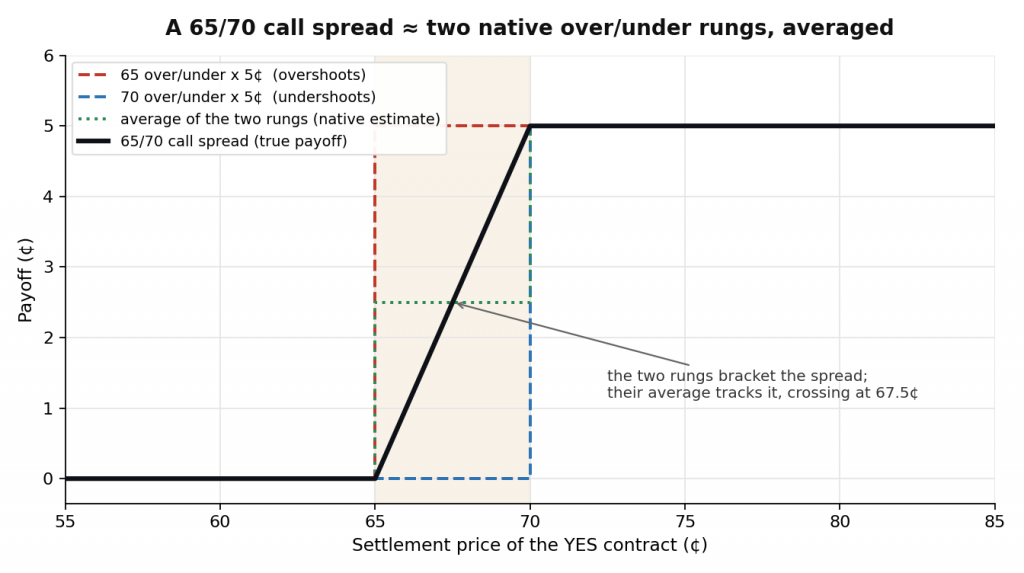
An outright call is slightly more involved because it requires a strip of those over/unders stacked from the strike upward. Either way, every option is a static basket of contracts the exchange can already issue, available with position netting from the account a trader already uses, and spinning up a fresh over/under at any strike or expiry costs the venue essentially nothing. So even in the world where demand exists and pricing is solved, the exposure people want is one the exchange itself supplies more cheaply. And the third-party options layer is left with little value to offer.
To be fair, there are edge cases where vanillas cover specific things the binaries can’t. But is it enough to justify the investment? Is there really a convexity play to be constructed over an underlying outcome settling in six months and averaging a few thousand dollars in volume per day?
Is the Word “Implied” Implied?
One claim I’ll push back on directly is the promise of volatility surfaces for the underlying markets. Most readers will interpret this as implied volatility surfaces extracted from live, two-sided order books in deep markets like equity or index options. A surface that a single firm simply publishes on its own isn’t particularly useful or credible. It needs to reflect real market consensus across strikes and expiries.
And that’s the problem. Convallax doesn’t operate like the continuous quoting environments that produce reliable implied surfaces. Instead, it uses a request-for-quote (RFQ) model: an option is priced only when someone specifically asks for it. There are no resting, continuous bids and offers across the full grid of strikes and expiries. Without that depth and liquidity, there’s simply no organic market data from which a meaningful implied volatility surface can be derived.
I understand the practical reasons for sticking with RFQ—you’d need exactly the broad, standing demand we’ve already established isn’t there yet. But marketing the idea of an implied surface that the current structure can’t realistically produce feels aspirational at best. It’s the kind of overreach that makes me want to re-examine everything else with extra scrutiny.
What It Leaves
I believe the idea of options on event contracts is a nonstarter for the foreseeable future. That’s not because anyone involved is wrong about something technical, but because the foundation isn’t there. No durable demand, no patient capital to create it, no tractable way to price the surface, and no moat even if all three were solved.
This doesn’t mean options on events are a dead idea forever. They just belong where the liquidity already lives—written on underlyings deep and continuous enough to support them (like Cboe with S&P 500 contracts)—not bolted onto thin standalone markets that can’t yet carry their own weight. The appeal was always real. The opportunity may be too, just somewhere else.
