

They price the number—not the reaction—so they may not be as useful as you’d hope.
On Friday the SEC published a proposal from NYSE Arca to list binary options on the key performance indicator (KPI) numbers companies report at earnings. Will Apple’s diluted EPS come in above a given level? Will Tesla build more than a given number of Model 3s and Ys? Will Marathon Digital’s mining hashrate clear a threshold? Each contract pays $1 if the reported figure meets or exceeds the strike and nothing if it doesn’t. The list covers 23 companies.
If this sounds familiar, that’s because Cboe filed the same product on June 30. And I do mean the same. NYSE Arca’s filing states that its proposal “is identical to the proposal made by the Cboe.” Everyone appreciates the transparency.
Cboe has been clear about what it thinks these are for. On its July earnings call, its head of derivatives described them as a way “to trade and manage the individual components that drive the company’s stock value. So, for example, think NVIDIA’s data center revenue, think Microsoft’s cloud-based revenue.” The target was an early October launch. The SEC has since given itself until October 13 to act, so that date is slipping.
In August I wrote that I hoped post-earnings price ladders were coming soon: binaries on where a stock finishes its earnings week, so the option chain would finally have a second opinion on the distribution it implies. KPI contracts are a different instrument solving a different problem, and neither one replaces the other.
Trading earnings
When you buy a call into earnings, you’re exposed to two unknowns: the number, and how the stock reacts to the number. Generally speaking, the vast majority of participants really only care about the second part: what will the stock’s price be after the dust settles?
However, EPS and price decouple all the time. Stocks fall on beats every quarter because guidance also plays a really important role in projecting future value. But you can’t really put contracts on guidance. Or at least you shouldn’t for obvious reasons.
The argument for KPI contracts is about moving upstream so you can directly trade the EPS itself as well as the KPIs that ostensibly drive it. It’s the perfect class of instruments for anyone who has ever complained that their modeling was perfect but the stock reacted differently than it should have.
What KPI contracts actually price
Each KPI gets a ladder of strikes above and below a reference level rather than a single yes-or-no, so together they price a whole distribution. If the ladder idea is new to you, the August piece walks through one on a real option chain.
The KPI market list runs at two depths. The headline numbers are there: diluted EPS and revenue for every supported company.
But most of the entries sit a step further upstream, on the things that produce those numbers: data center revenue, iPhone sales, Model 3 and Y production, net interest income, hashrate, and so on. The stock is downstream of EPS, and EPS is downstream of those. So the EPS ladder sharpens your expectation for the number, the operating ladders sharpen where it’s expected to come from, and none of it says a word about what the stock does afterward.
In other words, it’s a market on the number and not on the stock. That distinction does most of the work in what follows.
Who trades these numbers today
Every one of these numbers becomes public in three weeks no matter what, so a forecast of it is only worth something to people who have to act before then. A company that depends on NVIDIA’s shipments doesn’t reprice its business because a ladder moved. It waits for the print like everyone else. The people who act early are the ones holding a position that will reprice on the number.
Those people already trade these figures. They just do it through proxies. If you have a view on iPhone sales today, you express it through Apple stock or options, and the trade carries everything else in Apple along with it, most of all the reaction. A KPI ladder is the direct version of a trade people are already making indirectly.
The sharp end of that crowd has better information than a view. There’s an entire industry that exists to forecast exactly these figures: credit card panels for Target’s sales, app usage data for Meta’s daily actives, shipment and customs records for NVIDIA, scraped registration data for Tesla deliveries, supply chain checks on iPhone production. Funds pay real money for it, and today the only way to cash in a good read on iPhone revenue is to buy Apple and hope the stock agrees. A KPI ladder is the first listed instrument where a data edge pays out on the number itself. That’s a genuine customer, well capitalized, and already in the habit.
The operating ladders reach past the company
The EPS and revenue ladders are for people trading the company. The operating ladders are useful to people who aren’t trading it at all, because those numbers decide other companies’ quarters, and those other stocks reprice on the print too.
Cirrus Logic’s latest 10-K says Apple was about 91% of its net sales. Apple’s KPI list includes iPhone revenue. Apple reports in late October and Cirrus reports a week or so later, on the quarter in which it shipped the parts into those phones. So an iPhone revenue ladder settles days before Cirrus prints, on a number that is very nearly Cirrus’s own quarter in disguise. Nothing listed on Cirrus can express that, and a Cirrus holder has every reason to act before the Apple print.
The bigger version is compute. NVIDIA’s data center revenue is the supply side of AI compute: how many accelerators shipped this quarter. I spent a couple of weeks this summer on the demand side of the same market. The GPU rental ladders on Kalshi price what an hour of H100 or H200 time will cost on a future date. What you can’t get anywhere is the other leg: a tradable view on how much hardware is landing. Put a data center revenue ladder next to the rental ladder and both halves of the compute question have a price. Shipments up and rental prices holding means demand is absorbing supply. Shipments up and rental prices rolling over means the buildout is running ahead of use. Over the summer the H200 rental level held roughly flat while NVIDIA’s data center revenue rose 18% quarter over quarter. One data point, but every neocloud and server builder has a position that reprices on it.
Could a supplier hedge with these? Sort of. The contract settles once a quarter on a threshold rather than a level, in $1 units, and a beat on the number doesn’t stop the supplier’s stock from falling anyway. Hedging is the filing’s justification and I expect it to be the thinnest use. The real use is the one above: a clean place to trade a number that already moves your book.
Why the KPI contract was the easy one to list
Cboe’s CEO said on the same call that “what sets this product apart from competitors is the structure,” and that “these are securities products that should be overseen by the SEC and built within a framework of transparency and investor protection.” The competitors go unnamed. Neither filing mentions prediction markets, the CFTC, or any other venue at all, which for a product that pays $1 on a yes-or-no question is a conspicuous silence. I’ll leave the inference to you.
Whatever the motive, the KPI contract is the easiest binary a securities exchange could list. The settlement value comes out of a document certified by executives and prepared under GAAP, so nobody can bang the close on net interest income and the manipulation section practically writes itself. And it doesn’t sit on top of anything the exchange already lists. A price ladder on Apple would land on the most heavily quoted option surface in the world and either agree with it, which looks redundant, or disagree with it, which looks awkward. An EPS contract can’t embarrass anybody. The filing pitches this as the benefit: today investors “must rely primarily on equity options, whose pricing is affected by a wide range of variables.”
It isn’t that they can’t. Cboe already lists yes-or-no contracts on the Mini-S&P 500, right on top of the index option surface. And single-stock price binaries have a history, if not a happy one: the American Stock Exchange got Fixed Return Options approved in 2007, had to settle them on an all-day average price to keep anyone from leaning on the close, and they never found an audience. The KPI contract avoids all of that. It’s easy to list for the same reason it’s hard to check as a price. Nothing can contradict it, and the filing doesn’t even say what the opening reference level is, since there’s no traded number to anchor to.
Who’s on the other side
This is the part I’d want a newer options trader to think about before the first one lists.
The likeliest seller of your “Apple iPhone revenue above $X” contract isn’t an insider. It’s someone who bought better data than you. That’s legal, it’s what the product is for, and it’s worth knowing before you click. The ladder is where a paid-for read on the number gets monetized, and retail flow that bought because the phone looked popular is the other side of that trade.
Insiders are the second worry. Anyone who knows the number knows the payoff to the penny, and the set of people who know a large company’s production count before the press release isn’t small. The filing says the framework “preserves the integrity of insider trading prohibitions” and that trading will be under exchange and SEC surveillance, and I believe them. But I’ve written before about batting 1.000 on a baseball market, and the lesson there was that spotting informed flow is the easy half.
Then there’s timing. Every one of these expires on the earnings disclosure. But Tesla publishes production and deliveries a couple of days after the quarter ends, about three weeks before it reports, and Marathon posts its bitcoin production monthly. A Tesla production contract would have its answer in the public record for three weeks while it kept trading toward an expiration that’s a formality. That’s not a market so much as a settlement queue, and the filings don’t say how expirations will be timed around it.
Then there’s the market maker. The Cboe filing spends real effort on how a market maker’s quote is protected, and none on how the position behind it gets managed. I think that’s because there’s no good answer. You can’t hedge an EPS contract with the stock when the link between beats and price moves is as loose as it is. A quote that can’t be hedged gets wide, and you pay the width.
One more for the fine print fans: if the company later restates the figure, the settlement stands. You can be right about the real EPS and wrong about the contract.
I still want the ladder
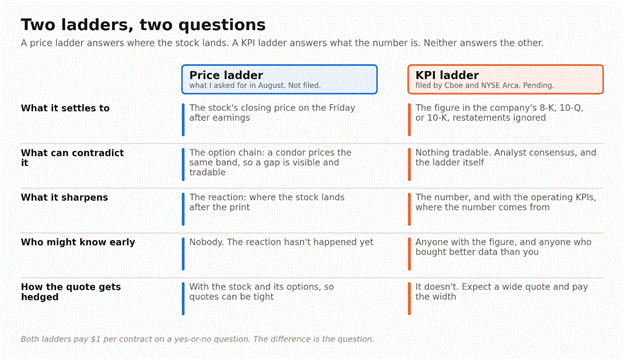
None of this changes what I asked for in August, because it’s a different question. A KPI ladder tells you what the market thinks the number will be, and the operating ladders tell you where it comes from. Neither tells you where the market thinks the stock lands, which is the question most people trading earnings actually have. Only a price ladder answers that with a price the option chain has to reckon with.
And the two together would be more than the sum of the parts. The KPI distribution gives you the number. The price ladder gives you the destination. The gap between them is the market’s view of the reaction, which no instrument expresses today. They answer different questions, and earnings season would be better with both.
Where I land
KPI contracts are going to give the people who already trade these numbers a direct way to do it, and the people best equipped to use them are the ones who paid for the data. None of it is approved yet. The SEC has until October 13 to approve Cboe’s version, reject it, or open proceedings, and it has comments in hand, so keep an eye on that date. Until then, would you trade a contract on a company’s reported EPS? And if you would, who do you think is selling it to you?
