

We need an accessible market sentiment alternative to Black-Scholes for earnings jumps.
I’ve been writing a lot about the potential for real crossover between binary prediction markets and traditional vanilla options. It’s mostly been about the emerging AI compute stack, from the options story through the crash it could defuse to a full derivatives stack priced off the ladder. This week I want to take one of the concepts from the AI compute discussion and apply it back to the world of equities: using a binary ladder as a better implied price distribution.
Let’s look at SpaceX, which reports earnings after today’s close for the first time ever. The at-the-money straddle that week runs about $20 on a $114 stock, so it’s pricing a move of ~17% by Friday. This number—the implied move—is quoted everywhere and is the basis for how many people trade the stock and its options.
Before I forget: I’m talking about earnings prediction markets, but I’m not talking about “earnings prediction markets”. Unfortunately, that term has lost all credibility as mention markets for people to gamble on what execs will say during the call. I’m talking about them in terms of a price ladder for the Friday evening immediately after a company’s earnings call.
The key place Black-Scholes breaks
I’m a believer in Black-Scholes, especially for longer-dated options. We need a standard way everyone can generally agree is fair for estimating the expected value of an option at expiration, and BS works well enough to keep the wheels turning. However, it assumes the underlying diffuses in small steps, which isn’t the case around major events like earnings releases. Then it extrapolates with a distribution that peaks at a near-zero move and hands you a fat, ordinary-looking probability of a near-flat finish, on the one night a first-ever print should be anything but ordinary.
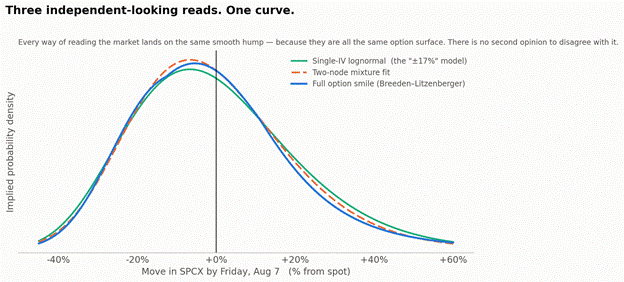
Every way I read this market lands on the same curve. Single-vol model, full smile, a flexible two-node fit, all of them collapse onto one hump, because they are all the same surface. That’s not confirmation; it’s monoculture. Whether the agreed shape is right is a question the market can’t answer today because there is only one instrument and it agrees with itself.
What the single number hides
The Breeden-Litzenberger method enables us to extract a probability distribution from an options chain. It’s not using a model, but rather pricing call spreads to infer the implied probability for each strike range. However, the prices are still fairly tightly bound to the IV-driven model, so they only offer a limited amount of extra wiggle to tease out more specific expectations.
Here’s what the chain is actually pricing for SpaceX’s earnings week the night before.
This data shows there’s about one chance in five that the stock finishes within 5% of where it started. There’s about two in five that it moves more than the whole $20 straddle. Its up-case centers near +18% and its down-case near −20%, with tails past +38% and −34%. There’s a quiet lean to the downside, 57/43, that the symmetric “+/-17%” cannot express. That shape is the thing traders are actually working with. A single implied volatility (or implied move) number throws almost all of it away.
But let’s actually dig into these numbers. Do you really believe there’s a one-in-five chance this stock barely moves after its first-ever earnings call? How much money would you put behind the scenario where SpaceX, with its 185% IV and $20 implied move, closes within $6 of Monday’s close by the end of its earnings week?
The number’s not wrong. It is what the volatility implies, and you could sell it if you wanted. The trouble is that the only way to fade it today is a complex options structure very few know how to trade, quoted by people all working inside the same framework. So it just sits there, simultaneously unbelievable and uncontested.
Can’t we just use options?
You can already price any band as a tight call-spread or condor. Buy the 109 call, sell the 110, sell the 120, buy the 121, and off Monday’s prices it costs about twenty cents to own the ±5% band. Twenty cents is the probability. The number is already there. What’s missing is a clean, accessible way for more people to trade those bands directly. Advanced shops already run multimodal models; this is about giving the broader market an independent, money-backed view instead of only the IV surface.
An alternative way to express an earnings view
So what would actually break the monoculture? A parallel ladder would give us the first independent measurement. Not a better model of the same prices, but a different crowd putting real money on where the stock lands, quoting the middle directly instead of inheriting it from a curve. If their prices disagree with the surface, that disagreement is information. And because the binary and the option chain live on the same stock, the arbitrage between them drags the surface toward the ladder. It doesn’t just reveal the shape, it disciplines it. The catch is that this only works if the ladder draws its own informed flow. If the depth is purely driven by dealer quotes off the surface then all you have is the same data in a different view.
Cboe has the parts, but…
Cboe already has the building blocks: call spread “prediction markets”, true binary The Plus Zone Minus™, and KPI binaries tied to specific stocks. None of them yet deliver a pure price ladder for individual equities after earnings. All I’m asking for is to combine those pieces so the market can trade the binary odds of finishing in each price band.
There’s no guarantee of success
While these earnings ladders could provide genuine insight into the expected distribution, it’s not without risk. And to be clear, none of this suggests that options are mispriced. The claim is that the shape sits uncontested when there are likely participants who would object if given an easy way to do so.
We still don’t know if there’s real demand for binaries among traditional finance, especially given how closely these instruments map to call spreads. Equity binaries have come and gone before, and the inescapable gravity of sports gambling may have made the class less appealing than it was last time around. Whether the appetite is different now is the open question, and I’ve passed on binary derivatives before for exactly these reasons.
A parallel binary price ladder would give the market its first real second opinion on post-earnings distributions. And the arbitrage between the ladder and the options surface would force that surface to take the disagreement seriously. Would you trade these earnings price ladders? If so, would you use them to replace option strategies or as a complement?
