
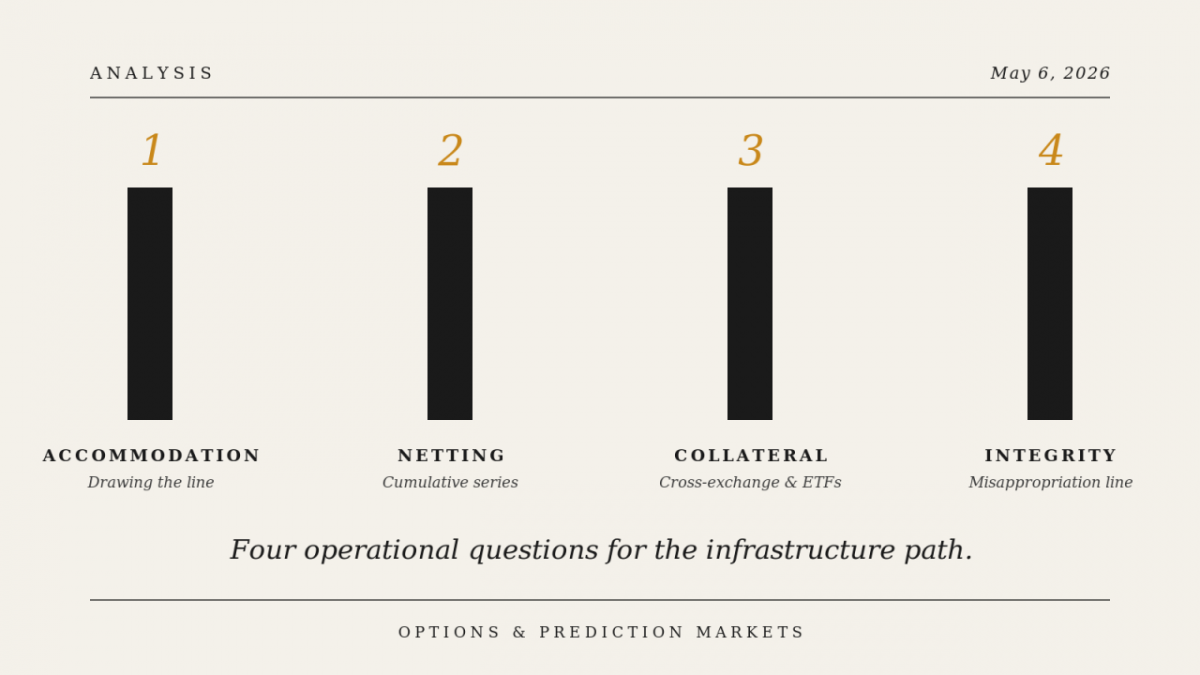
If the destination is mainstream investing, here is the work that gets us there.
Yesterday’s special edition issue argued that the CFTC’s prediction market comment record reveals a quiet consensus underneath the gambling debate: the CFTC is the right regulator, event contracts are derivatives, and mainstream investing access is the destination. The fight is about the shape of the path. This issue is about the path itself.
Four operational questions determine whether event contracts become infrastructure that traditional finance can responsibly serve, or whether they stall as a retail-flavored category outside the existing perimeter. These are the four I went deep on in my own filed comment letter to the CFTC. They are underrepresented in the comment record relative to their importance to where the category actually lands.
1. Drawing the line between contracts that warrant federal accommodation and contracts that do not
The CFTC has to decide which event contracts belong inside the federal financial market perimeter and which belong in some other regulatory framework. Most submissions answer this with categorical lists (sports out, elections out, weather in, regulatory outcomes in) or with state statute deference (whatever the state calls gambling, treat as gambling).
Both approaches are politically unstable. Categorical lists get litigated as the boundary shifts and as new contract types emerge. State statute deference imports the regulatory politics of incumbent gambling industries that have a structural interest in maintaining control over event-based risk transfer.
A more durable approach is structural. Ask whether a contract enables genuine risk transfer or price discovery for measurable economic exposure, or whether it has been designed primarily to optimize for engagement rather than for markets. I proposed three prongs in my filed letter: hedging utility, price discovery utility, and genuine risk transfer with measurable economic exposure beyond entertainment value. Contracts that satisfy at least one prong qualify. Contracts that fail all three may remain permissible under other regulatory frameworks but do not warrant the federal accommodation that DCM listing provides.
The structural test isn’t about what kind of contract it is. It’s about what kind of work the contract does.
2. Making intra-series netting work without compromising clearinghouses
Full collateralization is the right baseline for binary event contracts in the near term. A contract priced at $0.85 on Tuesday can resolve at $0.00 Wednesday morning when the event does not occur. There is no gradual loss for a clearinghouse to collect against; the position value can be extinguished instantaneously at resolution. Full collateralization fits that settlement dynamic. Variation margin doesn’t.
Within full collateralization, intra-series netting on direction market groups (cumulative event contract series in which the markets are not mutually exclusive) is already established CFTC-approved practice. Kalshi Klear’s DCO rulebook, registered by the Commission in August 2024, implements collateral return for direction market groups. When a participant holds offsetting positions within such a series, the bounded payoff range means the over-collateralized portion can be returned without compromising clearinghouse solvency.
Let’s walk through a practical example. Take a Fed funds rate market with cumulative thresholds and a view that the rate will be 3.5%+ but not 4.0%+. Pairing long YES on “3.5%+” with long NO on “4.0%+” creates a bounded position: at least $1 per pair regardless of outcome, $2 in the target range. If YES on 3.5%+ trades at $0.65 and NO on 4.0%+ at $0.70, the pair costs $1.35 in collateral. Without netting, all $1.35 stays locked. With Collateral Return recognizing the guaranteed $1 minimum, only the $0.35 at-risk portion is locked. Same exposure, roughly 75% less capital tied up. Option traders will demand this treatment.
And it isn’t just a proposal. It’s already running on at least one CFTC-registered DCO. The Commission should affirm intra-series netting on direction market groups as a baseline standard for any DCM clearing cumulative event contracts. Capital efficiency on range views matters for participants holding macro variable positions, and the regulatory precedent is already in place.
3. The cross-collateral pathway that lets traditional finance participate
Recent SEC filings for event contract ETFs (Bitwise, Roundhill, GraniteShares), the launch of perpetual futures on Polymarket and Kalshi, and the emergence of prediction market exposure within retirement asset distribution channels all signal that the regulatory perimeter around event contracts is already evolving past the binary contract on a single venue.
For traditional brokerage, custody, and asset management infrastructure to participate, the framework needs to identify how ETFs holding event contract positions could serve as collateral within a clearinghouse’s risk model, and how cross-exchange collateral arrangements between CFTC-regulated DCMs and other regulated venues could be structured. This is the operational architecture that lets institutional brokerage and asset management firms participate in event contracts within their existing regulatory frameworks.
Without it, institutional adoption stalls. Event contracts may get federal accommodation but never reach mainstream brokerage menus, because the integration architecture is not in place. If the destination is mainstream investing access, this is the load-bearing infrastructure question. It is the difference between a perimeter that exists on paper and one that is actually used.
These cross-collateral arrangements are also the infrastructure precondition for portfolio margin frameworks adapted to event contract portfolios. Once positions can be evaluated across products and venues, capital requirements can be calculated against a participant’s net risk rather than position by position—the standard methodology in established derivatives markets. That evolution is appropriate as clearinghouses build depth and participants become more sophisticated; it isn’t critical today. Full collateralization remains the right baseline for now. The cross-collateral pathway is what makes the longer horizon evolution possible.
4. The insider trading line: misappropriation, not asymmetry
Some recent commentary, including a piece in Fortune by George Mason economist Robin Hanson, has argued that allowing insider trading on prediction markets is a feature rather than a bug, on the theory that insiders have information that makes prices accurate.
This conflates two different things. Informational asymmetry is intrinsic to all markets. Trading on superior analysis or research is what price discovery actually means. On the other hand, misappropriation of material nonpublic information from a position of trust is a categorically different practice. CEA section 4c(a)(1) draws this line in existing law.
The Commission’s recent enforcement action in CFTC v. Van Dyke validates that the statute reaches event contracts traded on CFTC-regulated venues without requiring new statutory authority. The Van Dyke record is also instructive on the operational side. The trader attempted to open an account on a KYC-rigorous DCM and was unable to. He successfully opened an account on a venue with weaker controls and traded there. The KYC standard is not theoretical.
The framework should focus enforcement on the source and exclusivity of the information, not on the size or confidence of the resulting position. That keeps informed trading (the activity that price discovery actually depends on) categorically distinct from misappropriation (the activity that erodes market integrity).
Why these four?
These four questions don’t exhaust what the CFTC has to decide. They aren’t the controversies that dominate press coverage. But they’re the operational details that determine whether event contracts become genuine institutional infrastructure or stall as a retail category outside traditional finance.
The destination is set, revealed by the comment record consensus. The path is what we’re building. These four questions are the load-bearing pieces of that path.
I made the case for all four in detail in my filed comment letter. Full submission is on the public docket: https://comments.cftc.gov/PublicComments/ViewComment.aspx?ID=115402&GUID=7b83fb49-b49e-40e9-a567-320097ccc469.
