
A founder’s notes on eleven years of being early—and what finally changed.
I’ve been stalking prediction markets for eleven years.
The earliest thread I found is a 2015 email where I pitched one of Quantcha’s financial engineering advisors on the idea of “sports options”. This was well before the industry co-opted the term “prediction markets” from academia, and I was coming at it from a portfolio-management-through-derivatives perspective. I didn’t even think of what I was describing as a prediction market. I thought of it as a vehicle for sportsbooks to hedge their outcome risk and offer customers more sophisticated products.
I took the idea to a few BD-minded founders, and had long, productive calls with others who had launched their own exotic-derivatives ventures. In every version of the conversation, the opportunity hinged on the same thing: liquidity. It would not work unless I could bring in participants willing to buy and sell—ideally both—in size.
Nobody was ready
Another lesson came out of those calls: you cannot build this on speculators. A market like this only works when both sides have a real reason to be there—when at least one of them is moving genuine risk, not just taking a view.
The sportsbook version had a flaw I couldn’t design around. It seemed impossible that sports betting would clear at the federal level, so the product had to stand on its own as genuine risk transfer. Unfortunately, a sportsbook laying its book off onto a crowd that just wants the other result isn’t moving risk to a hedger; it’s finding more speculators. It’s gambling with extra steps, and I could never draw the line cleanly.
I went looking for cleaner ground—places where the risk being transferred was unambiguous. In 2018 and 2019 I tried approaching casinos and tribes on a syndicated market-making system that would pool liquidity across venues. I pitched insurers on a model for socializing weather risk—trading out of exposure to temperature and other weather phenomena. When the lockdowns hit in 2020, I angled toward state governments with exchanges where tourism-dependent businesses could hedge against the next shutdown (or even just underperformance).
The conversations were warm, but nobody moved. The conditions weren’t there—regulatory, institutional, or otherwise—and nothing on the horizon looked strong enough to change that. I wasn’t wandering between those industries at random. I was running one test in each of them—is there a counterparty here with a real risk to move?—and getting the same lukewarm answer every time.
Proving the concept
I did build something, though. When COVID locked down Washington State, I had about 20 hours a week back—time I would otherwise have spent coaching youth teams and running school clubs—and I put it into the infrastructure as a passion project. I built it generic on purpose: a core platform (exchange, clearing, custody, arbiter) with a thin adapter layer on top, so the same engine could be quickly adapted for sports, insurance, public statistics, or whatever vertical came next.
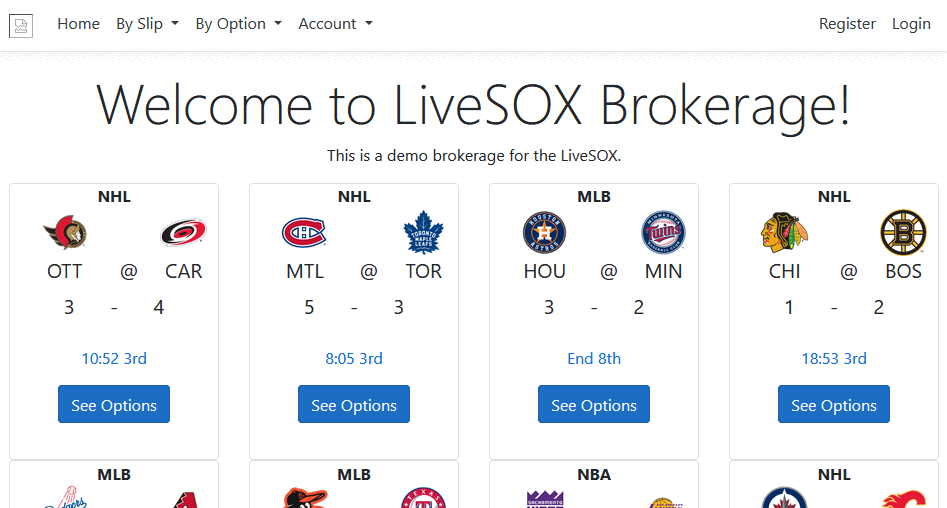
Live Sports Options Exchange (livesox.com at the time) became the first reference implementation. It was a fun concept to build for and a good way to demo. It had a brokerage frontend, an arbiter service, and two bots: one took out simple price arbitrage, and the other made markets by inferring a rough distribution from published moneyline and over/under odds. The currency layer was pluggable, so the whole thing could run end to end on test credits while the capital and regulatory structure got worked out separately.
One benefit to the implementation was that it gave me a complete view of what building and operating a system like this would require. But, perhaps even more valuable, it also let me dogfood the actual user experience beyond the software. That was eye-opening, because I started to have real doubts about the end-user use case. It made sense why someone would want to take the “over 40.5 in Sunday’s Seahawks game,” but it was much less clear that it would translate into enthusiasm for the “over 4.5 Atlantic hurricanes this year.”
The great thing about having the sunk cost of operating Quantcha is that it’s easy to spin up these prospective ventures and let them coast in case something catches fire. They never have to die…until the domains come up for renewal.
Someone actually pulled it off
Meanwhile, companies like Kalshi and Polymarket broke through. It’s easy to be impressed with what they’ve done as a casual observer, but I remember looking at the daunting requirements to solve for the regulation and other legal issues at the time and deeming it impossible. It’s now as easy to set up and trade event contracts on one of them in the US as it is to open a traditional brokerage account and trade options. Actually, it may be even easier given options-approval overhead.
They’re making inroads—or at least establishing policy—to appeal to businesses looking to offload risk. Kalshi has incentive programs for sportsbooks and sports contract insurers that may already be playing a meaningful role in the transactions that dominate its volume. These are legitimate derisking scenarios where those companies can lose on their Kalshi trades and still come out better overall given the hedging purpose those positions served.
What I’m not sure they’ve solved is the fundamental end user problem: can they get investors to trade event contracts? I don’t have any special insight here, but the conventional wisdom is that their retail flow is predominantly gambling (or, more generously, “speculating”). Without a critical mass of traditional investors onboard, it will be tough to attract other industries looking to derisk.
Look out for strong headwinds
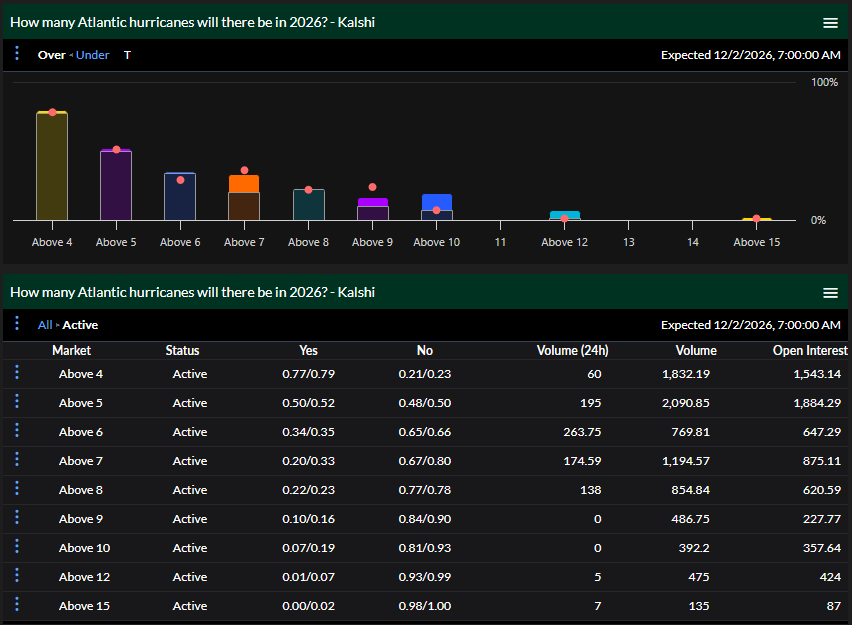
Consider Kalshi’s market for “How many Atlantic hurricanes will there be in 2026?” It’s the middle of May, and the open interest is 6,667 across nine threshold markets. That represents under $7,000 against the potential for tens of billions of dollars in damage. There is obviously not enough interest on both sides for this market to have a meaningful impact—yet.
Getting demand for Over is easy. Insurers would love to offload risk if they can get a better expected value for their whole book. They’re probably not involved yet because there’s no meaningful Under demand. That demand would have to coalesce from the broader market.
My gut feeling is that investors, especially retail investors, do not want to trade these individual contracts. They would be interested in the exposure at the right price, but they also understand the kind of research and monitoring commitment they’d be making by getting involved.
Funding the future of prediction markets
If I’m right about that, then the best solution is a Closed-End Fund. And I don’t mean the proposed ETFs that wrap a specific event contract—I mean a discretionary fund managed for exposure to the different kinds of risk that prediction markets (and other modalities) help quantify. There are a lot of edges to smooth out, but this approach would give a retail investor the easiest way to express a view—“I think this season is going to be less risky than the premium implies”—and have that ultimately connect to the insurer looking to offload the risk.
For a long time, the honest answer to all of this was “not yet”. No venue, no liquidity, no regulatory ground to stand on. The thing I kept circling couldn’t actually succeed, so I didn’t build it. That part is over. What’s left is no longer an impossible problem, just a hard one: find the demand that sits across from the insurer and give an ordinary investor a reasonable way to supply it. A discretionary fund is one shape that bridge could take. There are surely others. I don’t know yet who builds it or how. I do know that, for the first time in eleven years, it’s a problem worth trying to solve rather than one to wait out.
If you’re an investor, insurer, or operator thinking about this space, I’d love to hear how you see the demand-side challenge. Drop a comment or DM—happy to compare notes.
