
The roadmap to traditional option strategies on Kalshi may be closer than I dreamed.
I’ve been doing a lot of mental gymnastics to tease out an angle to pitch event contracts to options investors. I feel like this is an audience that needs to be won over for these instruments to have a future.
I know that CBOE has their own flavor of prediction markets, but those weren’t what I was looking for. There are also efforts to deliver vanilla options on specific prediction binaries, but that seemed like a non-starter to me as well.
I even wrote about how the Kalshi American Power Index could enable a specific kind of income strategy in the form of calendar trades. I didn’t love the approach, but it seemed like it could evolve into something.
Then this week Kalshi launched forward curves for GPU compute prices and it all snapped into focus. The curves would be derived from a matrix of threshold markets across a term structure. The same underlying compute price is also getting a forthcoming perpetual futures contract—a perp that tracks spot directly rather than being derived from the curve, and a truly continuous underlying on which options could be struck.
Why binaries were never options
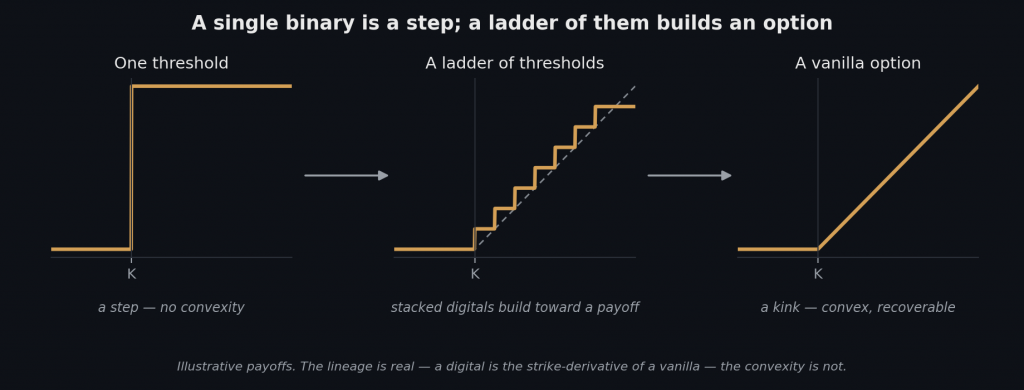
A standalone binary contract is not really an option in the put/call sense. It settles to zero or one. That single fact, more than the absence of Greeks, is why the options playbook never migrated into this space. I have argued before that the Greek apparatus does not port cleanly to binaries because they have no convexity and no recovery.
The most impactful thing to deliver for option traders is probably the most successful retail strategy: the One Man Insurance Company. You sell a put, collect the premium, and roll it. If it goes against you and you get assigned, you end up with real asset at a known basis that can recover. So you write calls against it while you wait and continue to collect premium.
The whole strategy survives its losing trades because the losses are recoverable. Run that same trade on a binary and a loss is total and final. You are not put a recoverable position. You simply lose the notional and it’s over. An insurance company whose every claim is a total loss cannot run a book. That is precisely why prediction markets, for all their elegance, were never a home for income strategies. (And yes, you can pick an underlying that never recovers and ultimately lose on the trade. I mean that YOU can—I obviously never would.)
I do want to get pedantic for a second to avoid being sloppy. All of these zero-or-one markets are event contracts. Only some of them are binary options. A contract on a threshold—will a GPU-hour clear $4—is a binary option in the full sense. It’s the strike-derivative of a vanilla, sits on a continuous underlying, and a ladder of them recovers a distribution.
A contract on a categorical outcome—like who wins an election—is a pure event contract with no underlying, no strike, and nothing to inherit from the options world at all. The election is the true dead end. The threshold at least carries the lineage, which is why it gets closer than anything else in this space—and, as we will see, why it still is not enough.
Threshold surfaces don’t quite cross the threshold
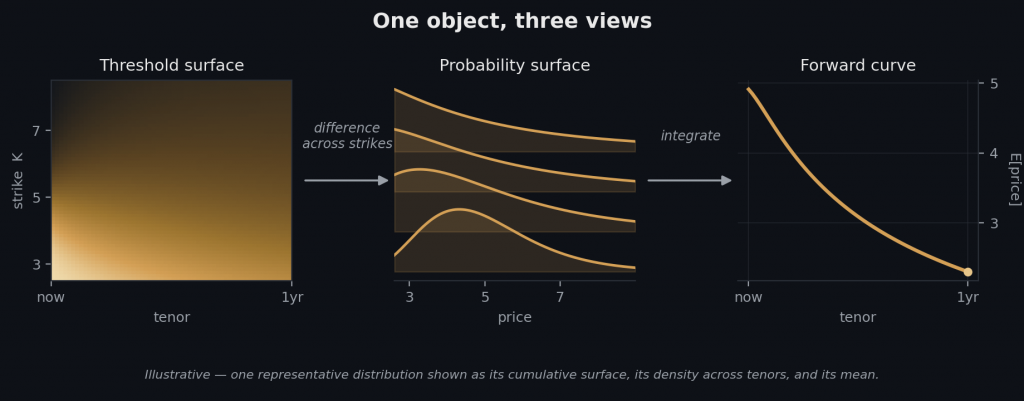
Kalshi’s chip markets are ladders of cumulative threshold markets across many strikes and several tenors. Stack them and you get what I would call a threshold surface—the raw, market-quoted object. This gives you insight into where the market expects prices to exceed over time.
Difference it across strikes and you get the probability surface. These are the implied odds of the price landing in any given range (subtract the odds of $5.50+ from $5.00+).
Integrate that, and you get the forward curve Kalshi just published.
It’s three views of one thing: the market’s full distribution, its density, and its expected value.
It is a genuinely elegant data object, and you can synthesize put-like payoffs out of it. But you inherit the original sin: every threshold in the ladder still settles zero or one, so the synthetic short put is still irrecoverable at the strike. The surface is great for pricing input but poor for writing insurance.
The compute curve rounds out the story
The compute markets settle to the Ornn index: dollars per GPU-hour. That number is unbounded, real-economy, and continuously priced. For the first time, the event contract stack has produced a price—not a probability—as its underlying. That is the piece the American Power Index could never provide: an index bounded between 50D and 50R, it’s still a probability—compressed tails, a pull to the middle, nowhere to run—while a GPU-hour is an unbounded dollar price that behaves the way option math expects. And Kalshi has explicitly said perpetual futures on these metrics are next. Without those perps there would be nothing for market makers to cleanly hedge with, so they’re critical to this all working.
As a quick aside, this sort of industrial metric underlying is very cool. You can’t easily isolate these things for trading today. You could trade Nvidia, but there’s a lot more going on with respect to its pricing, so you’re not getting purity. An industrial-metric perp is a beautiful play, and I suspect compute will be the first of many. I’m eager to see what else gets this treatment.
The options you didn’t know you wanted
If you’re familiar with vanilla options, you already see the potential. But what if we went further? What if the options never expired?
Perpetual options use the same funding mechanism as perpetual futures to provide the same conceptual exposure as term options, but without the management overhead. In a world of $5.00 GPU-hour pricing, you could write a $4.00 put and receive funding payments that are analogous to the roll premium and theta decay you’d get from a rolling put or wheel strategy. You wouldn’t touch the position until you wanted out.
It still carries similar risks, so you would lose money if the underlying dropped too much and persisted for too long. But you’d be in a recoverable position with the option to stick it out like you would with rolling options.
The usual caveats
I should be clear that all of this options talk is speculative. There have been no announcements that I’m aware of and I haven’t seen anything buried in the API that indicates this is being built out. But it seems like a natural step and would bring an engaged and capable source of demand (and likely liquidity) to the underlying prediction market stack.
And even if every instrument I’m describing ships, writing insurance only pays if the underlying actually carries a volatility risk premium worth harvesting. Whether GPU-hour prices do is unproven, and it could compress or even flip against you the moment everyone piles into the same put for income. The plumbing being possible is not the same as the trade being profitable. Regardless, we still don’t know if they will even ship it.
But it sure would be a lot cooler if they did.
