
Opportunistic marketing or a path to an event contracts future?
I have, it turns out, been living in The Plus Zone for years without knowing it. That’s Cboe’s name for the sloped middle of a vertical spread—the part that pays out proportionally between the strikes—which I’d always thought of as simply how a spread works. Apparently it’s a feature now, and an admirably well-named one. My hat is off to the marketing wizard to coined that one—I’ve been in your exact situation and recognize your game.
But the branding really does work. I laughed out loud when I read the description, and that made me curious enough to read the actual filings. The deeper I went, the more I kept circling one question. It’s not whether this thing is gambling (the fight the media savors) but rather who it’s actually built for.
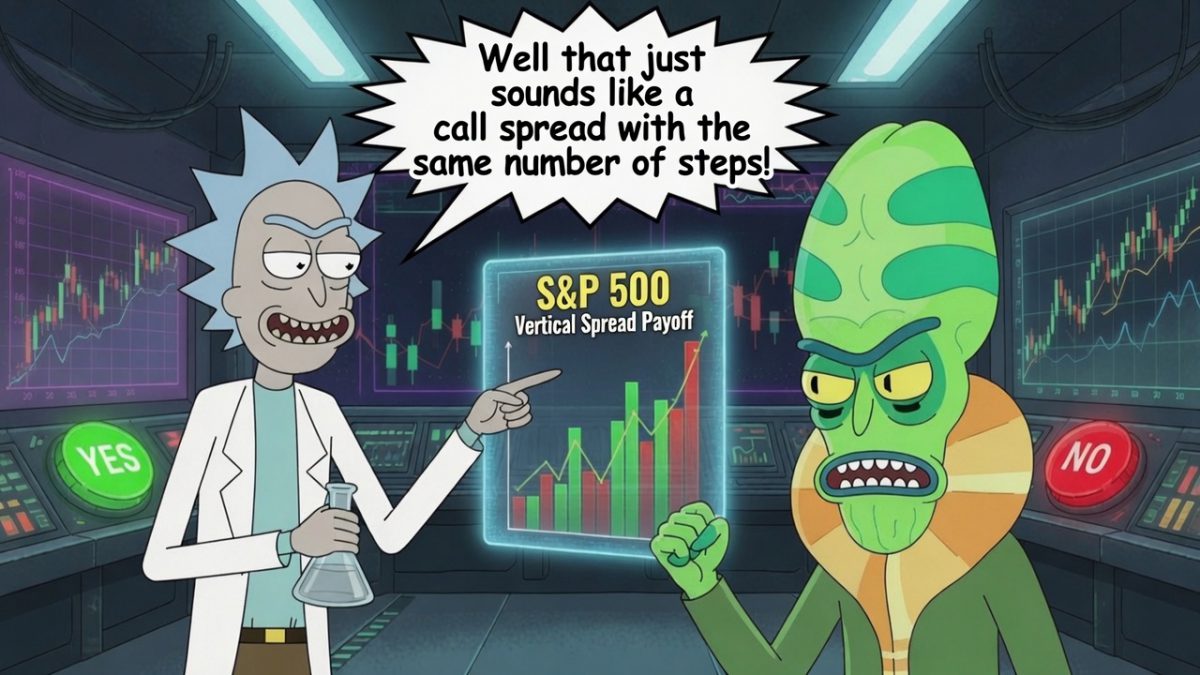
Cboe’s own documentation says as much: the verticals are “not a separate product” but rather “standard XSP vertical spread strategies.” So if you buy one, you’ll end up with a call spread in your book. As a result, it also requires options spread approval on your account.
Are prediction markets crossing over already?
Last week, Schwab announced that they would soon be supporting these spread products through a partnership with Cboe. But what really stood out to me was that both they and Cboe position them as “prediction markets.”
I’ve regularly used Schwab as a landmark in my exploration of what it will take to get broad adoption of event contracts in mainstream finance. I’ve made cases about the risk of the toxic term “prediction markets” and the need for consolidated clearing across multiple competing exchanges, plus several other missing pieces I thought were blockers to the new asset class.
But it turns out that I was overthinking it. The missing piece was the humble call spread.
The experienced options traders out there may ask, “if it’s just a 0DTE call spread on XSP with a $1 strike width, can I just trade them on my own today?” The answer is yes. Yes you can.
They’re not exactly what I’d consider “prediction markets,” but I’m also the guy who had no idea about The Plus Zone until the press release came out, so maybe my expertise has reached its limit.
But what if The Plus Zone is too much for me to handle?
Good news—they’ve thought of that, too. Alongside the XSP vertical spread product they’re also going to support a true binary threshold contract. It’s effectively the same as the spread, except that there’s no Plus Zone. I’ve suggested “The Plus Zone Minus” as the official name of this new offering, but I’m pessimistic.
This product is simply a Yes/No contract for questions like “Will XSP close at or above $750?” It’s a little trickier to hedge given the jump payoff, but that’ll get baked into the pricing. Plus, it’s a lot closer to the prediction markets you see on exchanges like Kalshi.
So then who are these markets for?
Let’s work down the list.
- Not the prediction market audience. People who want a simple yes/no without an options account can’t access them. A fraction of the Kalshi and Polymarket crowd might cross over, but I’m skeptical—the options-approval gate is exactly the friction they came to those platforms to avoid.
- Not active options traders. Anyone with options approval can trade these same spreads directly, at any width or expiry, and adjust or roll them. The packaged version only removes that flexibility. I’m skeptical they’d ever want the pure binary version.
- Not hedgers. 0DTE and 1DTE options have very limited utility when it comes to hedging. Outside of the few big macro events like Fed decisions or CPI prints, they’re just not useful.
- Not position traders. No term structure and dollar-wide zones mean there’s little to build.
- Not institutions. They already have the full options toolkit.
This really only leaves two groups. The first are users who are able to “prove” their option competence enough to get spread approval but not capable enough to trade them properly.
The second are amateur automated traders. These are the people convinced on Reddit and Discord that they could vibe code bots to skim a spread off “dumb money” that turned out not to be there. Instead, they largely pass contracts back and forth among themselves all day. I won’t comment on what percentage of volume share I think they represent on platforms like Kalshi and Polymarket.
A rung, not a destination
But I have hope for the overall strategy. If you step back, the product looks less like a standalone idea than a step in a sequence. Line the instruments up and each is the previous one with a feature removed:
- Puts and calls: continuous payoff, a real underlying, an open-ended tail.
- The Plus Zone (a vertical): cap the tail, producing defined risk and reward with a ramp in between.
- The “Plus Zone Minus” (a binary): remove the ramp for an all-or-nothing at one strike.
- Event contracts: remove the numeric underlying entirely, leaving a yes/no on something with no price beneath it, like an election or the weather.
That’s the whole range, from the richest options instrument down to the barest event contract, each step shedding one thing.
To be fair…
None of this makes the product a bad one. The defined-risk structure is real. Your maximum loss is the premium you paid and it’s easy to understand. And if you want a capped, simple entry position on where the S&P closes today, it delivers exactly that. It’s clever, it’s legal, and it’s well-built.
I just don’t think there’s real demand for it. The experienced trader has better tools. The prediction market user can’t easily get in. The hedger and position trader were never the point. But if it’s a means to an end, then maybe it’ll all be worth it.
