
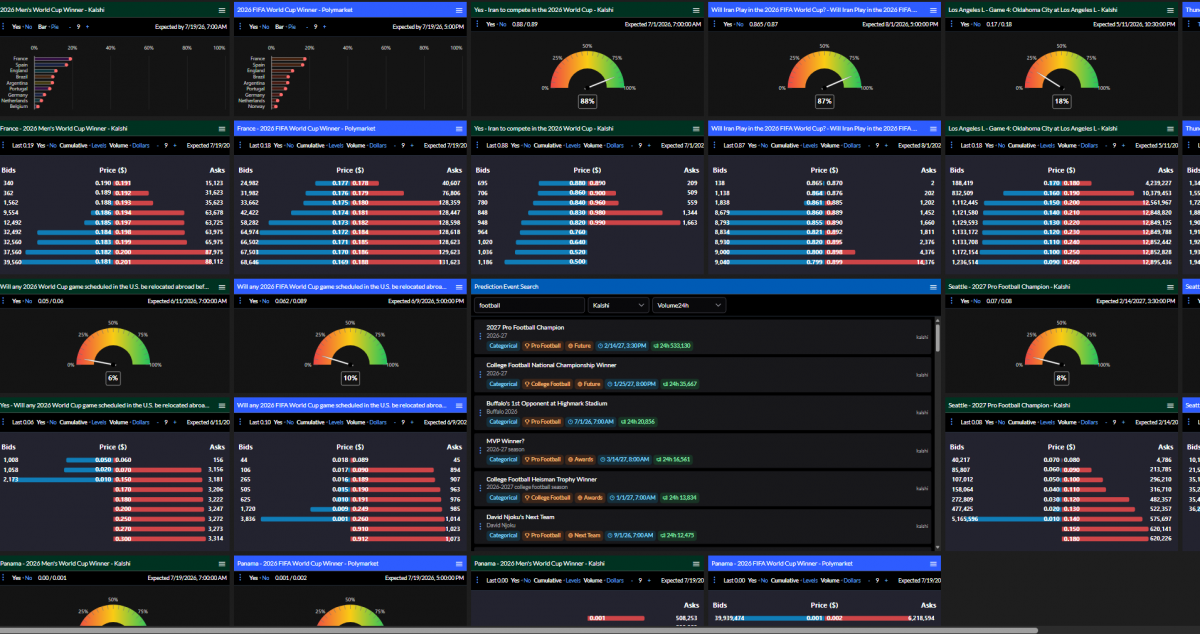
A post on X this weekend identified what its author called a simple inefficiency in Polymarket’s 2026 World Cup winner market. The reasoning was that if you add up the displayed odds on the fourteen favorites it would come to about 88%. If you bought 100K contracts of each, then you’d spend $88K to collect $100K when any of them won on July 20. A clean $12K return locked in by midsummer for nearly 14%.
There was obviously no way this could be true, so I quickly fired off a skeptical comment and made a mental note to fact check later on (if there was time). Don’t blame me—those are the terms and conditions of using X.
Curiosity ended up getting the best of me, so I actually did look into it. After working out the numbers at the time (~36 hours after the post), the basket cost came to $93K after order book lift and fees. It’s not exactly risk-free arbitrage, but it’s still a reasonable position to consider for the relative tail risk.
The surprise
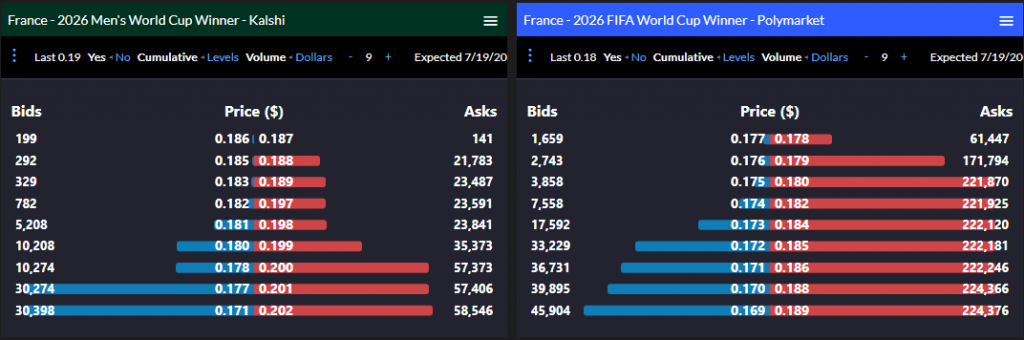
While I was checking the basket math against the books, I noticed something else. Pulling France’s order book on Polymarket—the most-traded contract and favorite in the event—I noticed the best ask sat at $0.178. I sanity-checked the same contract on Kalshi. France there sat at $0.187 on the offer side. Identical underlying outcome, 90 basis points apart. That’s a meaningful gap, and unlike the basket trade, it actually looked like real arbitrage.
The textbook arb is straightforward. Buy France Yes on Polymarket where it’s cheap. Buy France No on Kalshi where it’s expensive. The basket pays $1.00 either way:
• If France wins, the Polymarket Yes settles to $1.00 and the Kalshi No to zero.
• If France loses, you get paid the $1.00 on Kalshi instead of Polymarket.
The total entry cost per share pair: $0.178 + $0.814 = $0.992. Gross profit: $0.008 per pair. That’s about 80bps of risk-free return locked in over six and a half weeks, plus whatever yield the platforms pay on the locked capital. That sounds like a real free trade.
I went looking for the catch.
The first answer: fees
Both venues charge takers on a quadratic formula where the fee is a function of the number of contracts, trade price, and a taker rate. The quadratic nature is designed to max at peak uncertainty ($0.50) and trail off at the edges. The symmetry ensures the same fee applies at $0.30 and $0.70 to disincentivize siding gymnastics.
The base taker rates differ. Kalshi charges 0.07 across the board. Polymarket charges it by market category:
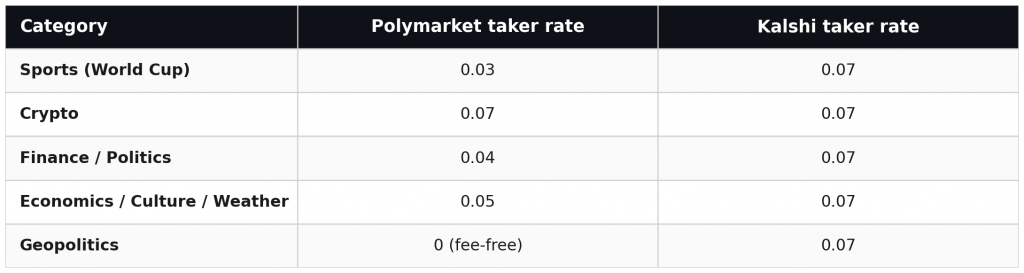
On the World Cup specifically, Polymarket’s sports contracts charge three-sevenths of Kalshi’s rate. Here’s the arb math per share pair:
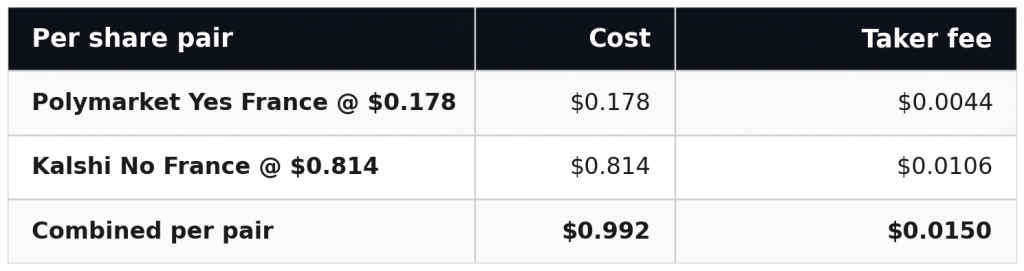
The gross arb spread is $0.008 per share pair. Combined taker fees are $0.015 per pair. Net of fees, the trade is a $0.007 loss per pair, which is about 70bps on the basket cost. The fees alone close the case for the strategy.
Good. That explains why the arb doesn’t get done. But it doesn’t explain why the 90bps gap exists in the first place. Fees prevent it from being captured. Something else has to be creating it.
The candidates that fell short
I tried APY first. Both venues pay yield on positions: Polymarket at 4% and Kalshi at 3.25%. The 10-year Treasury at 4.384% as the reference rate as of this writing. The 75bps APY differential means makers on Polymarket earn more on locked capital, which translates to a lower breakeven ask for the same expected return. The magnitude over a 75 day holding period works out to 15-25bps in the right direction. It’s substantial and in the right direction, but not enough.
Maker fee asymmetry was the next candidate. Polymarket sports makers face zero direct fees plus an 11bps rebate from the maker rebate program at France’s price level. Kalshi makers pay 25% of the taker fee, which is about 27bps at $0.187. The net swing in maker economics is 25-40bps. Also in the right direction, but even when combined with APY it’s only 40-65bps against a 90bps gap.
Demand-side asymmetries came next. Kalshi runs a Sportsbook Hedging Rebate Program that rebates taker fees for US-based sportsbook operators hedging their book exposure. Sportsbooks running parlay and futures books on the World Cup are short the popular favorites, which means they buy Yes on those favorites to hedge. This introduces directional buy-side pressure on Kalshi that would help push in the right direction. It’s a plausible contributor, but it’s hard to size precisely from outside and doesn’t seem to close the magnitude gap significantly.
Stacking everything quantifiable in the right direction got to 60-70bps of the 90bps gap. In a world where the kind of money that can move markets likely has access to either exchange, what could the reason be for the rest of the gap?
Let’s hear it for the longshots
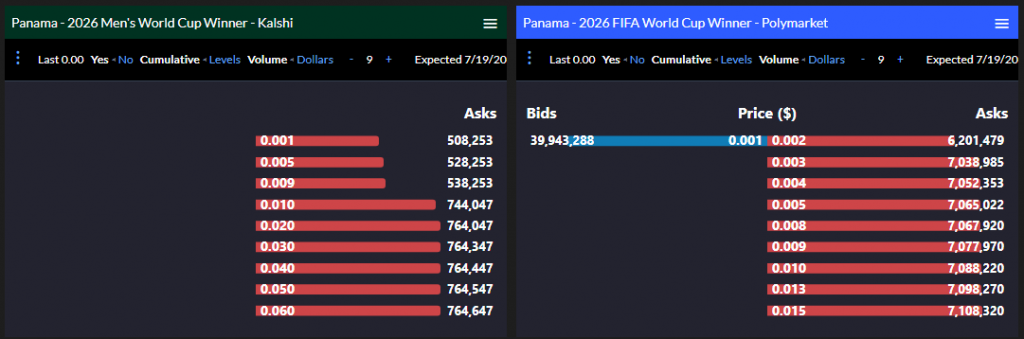
One of the odd observations I noticed across exchanges is that the longshot liquidity on Kalshi is understandably low while the same liquidity on Polymarket is unbelievably high. Even setting aside Panama’s home field advantage on Polymarket’s international exchange, the fact that they have over 7M contracts on offer below a penny and nearly 40M offers to buy at the $0.001 level seems…surprising? But it’s actually the same for all the longshots. Kalshi has no buy interest on any of them, but Polymarket has millions of resting offers to buy any longshot. In fact, the volume on both sides of the spread thins out as the teams become more competitive.
The structural answer
Polymarket—specifically the offshore entity running on Polygon—has an atomic split-and-merge mechanism. This crypto process works notably different than the DCM model operated onshore under the CFTC and changes the nature of how market makers operate.
For maximum capital efficiency, market makers split USDC into a set of tokens that represent every possible outcome for the “2026 FIFA World Cup Winner”. They then trade these tokens as markets in various combinations across Polymarket. At any point they can get a full set that they merge back into USDC. I’m oversimplifying, but it’s a critical part of their infrastructure that allows convenient conversion between tokens that represent positions and cash that can be executed unilaterally—in seconds and without a counterparty.
Remember those longshot bids? It’s not because they think Panama is the next Ecuador. Market makers need those cheap tokens to balance their books and merge complete sets back into USDC.
This has a pinning effect on the sum of market probabilities within an event such that the total probability remains very close to 100%. On exchanges where all contracts are independent—like Kalshi or Polymarket US—market makers need an overround buffer to account for a variety of risks.
The financial engineering term for what this enables is zero basis risk on balanced books. A Polymarket maker holding inventory across all teams, which is naturally produced by the mint operation, can reclaim collateral instantly whenever inventory balances out because the protocol recognizes that exactly one team will win and the entire basket is worth $1 at resolution. There’s no capital lockup cost and no carry overhead. Their marginal hedging cost on this negative risk market is effectively zero.
That “negative risk” concept is key here because it also enables them to sell No on multiple teams without having to collateralize every position. They bought the full set of tokens for 1.00, so they can sell whichever ones they want without investing additional capital to cover the downside.
Kalshi faces positive marginal hedging cost. Each contract is independently created by the matching engine when a buyer and seller cross. No participant can unilaterally mint or burn complete sets. The only equivalent to Polymarket’s atomic redemption is to buy a complete set of Yes tokens at the asks and wait until resolution to collect $1. For a 75 day World Cup contract, that’s locking $1 of capital per share set for the entire time, with an opportunity cost of roughly 2.5 cents per set at the gap between Treasury yield and Kalshi’s APY. The arb only fires when the gap is wide enough to clear that penalty.
The practical consequence is that Polymarket’s sum of midpoints on the World Cup market is constrained by atomic arbitrage to sit very near $1.00 in real time. Kalshi’s sum can drift above $1.00 by something like 150-250bps before the wait-until-resolution arb starts to fire. This is the venue’s structurally allowed overround. Within that float band, the marginal hedging cost asymmetry between the venues’ market makers manifests as Kalshi midpoints drifting in the direction of accumulated inventory imbalance, while Polymarket midpoints stay closer to fair value because the structural mechanism prevents the same kind of one-sided accumulation.
That’s the structural answer. It’s not APY, it’s not fees, it’s not the maker rebate program, though all of those contribute to the magnitude inside Kalshi’s float band. It’s that one venue has an atomic within-market arbitrage that the other doesn’t, and that single architectural difference does most of the work.
What the pattern looks like across markets
That mechanism makes falsifiable predictions about how cross-venue gaps should behave on different market shapes. Four observations from this weekend across different event types:
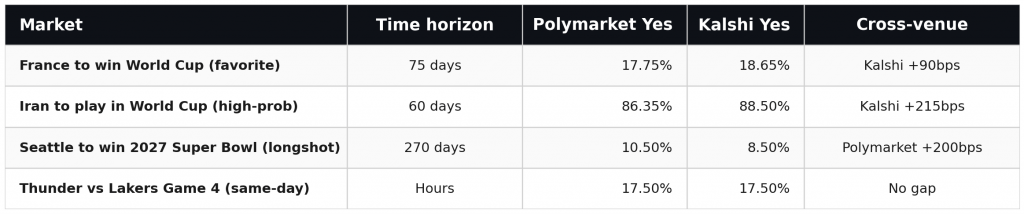
The pattern is consistent with the structural argument once you allow for three qualifiers.
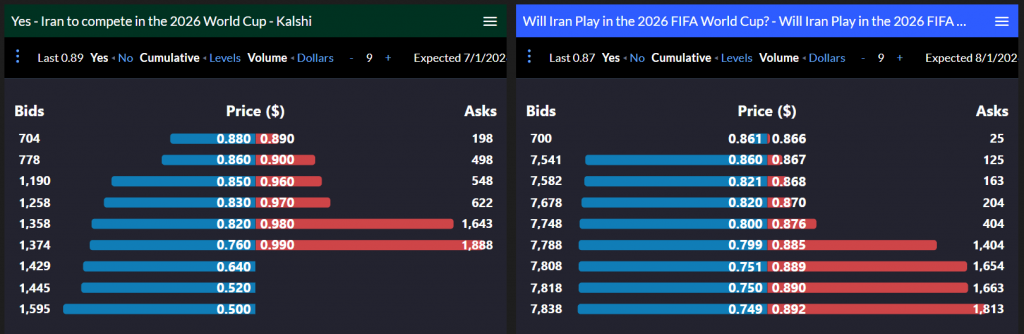
First, the direction depends on how participant flow accumulates inventory on Kalshi. On the World Cup market, US retail flow concentrates on the popular favorites, like France, Spain, England. Kalshi makers selling Yes on the favorites accumulate short favorite inventory, raise the midpoint to compensate, and the cross-venue gap shows up with Kalshi higher on the favorites. The Iran-to-play binary follows the same pattern: insurance-style Yes buying on a high-probability outcome pulls Kalshi above Polymarket by 215bps.
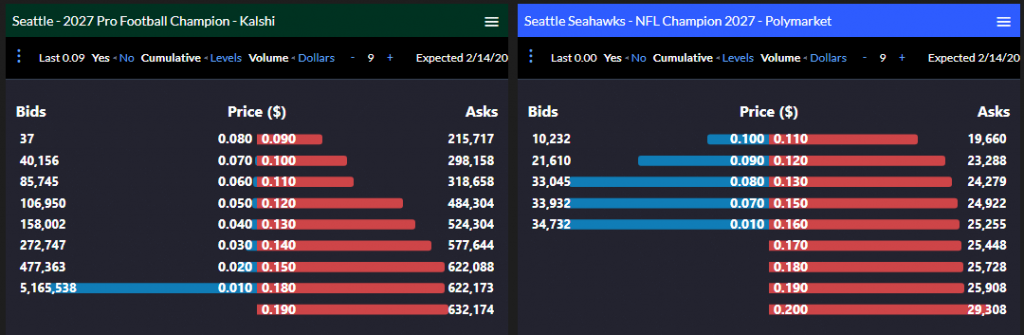
On the Seattle Super Bowl market, the dynamic reverses—US retail isn’t buying Yes at the moment, so Kalshi makers accumulate Yes-Seattle inventory the inverse direction. They clear it by lowering the midpoint, and Kalshi sits below Polymarket by 200bps. It’s the same mechanism, but in the opposite direction, and predictable from whether the contract is a favorite or longshot in the Kalshi participant base.
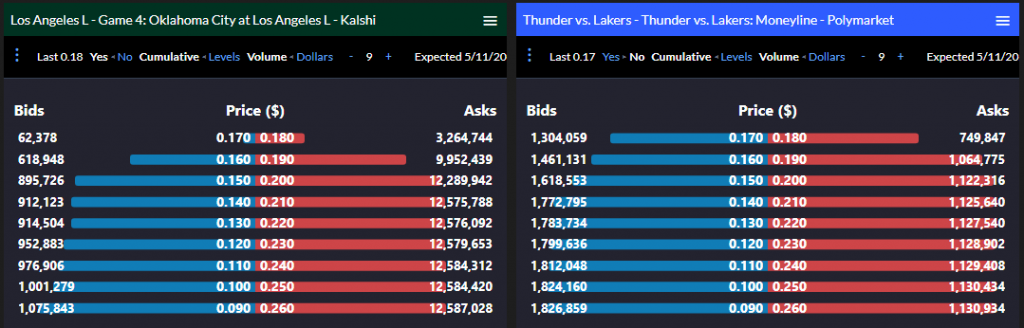
Second, the asymmetry only manifests when time to resolution is long enough for it to matter. Monday’s Lakers/Thunder NBA playoff game has the underdog Thunder priced at 17.5¢ on both Kalshi and Polymarket. It’s an identical bid/ask with no cross-venue gap. With hours to resolution rather than months, the opportunity cost of locking capital on either venue is essentially zero, so the wait-until-resolution arb on Kalshi becomes nearly costless to execute. Kalshi’s overround compresses to match Polymarket’s pegged equilibrium. The structural asymmetry only produces visible cross-venue gaps when capital has to sit long enough for the cost differential to accumulate.
Third, independent contract models like Kalshi require market makers to find counterparties for every trade. When inventory starts to build up there’s pressure to offload that requires price adjustment that may not be in line with market views.
In other words, it seems clear why Yes prices are higher on Kalshi than Polymarket. But since those same rules should also apply to the No contracts, why aren’t those more expensive as well? Why are we seeing sub-penny spreads on popular markets instead of Yes and No prices that are both more expensive than their Polymarket counterparts?
The easiest explanation is that Kalshi traders have a bias towards buying Yes. As Yes demand floods in, Kalshi market makers accumulate one-sided inventory risk. To attract the No side necessary to balance their books, they don’t just widen spreads; they must structurally lower the No price to a level that incentivizes professional arbitrageurs to step in. In this light, the cheap No on Kalshi isn’t just a pricing error. It’s a liquidity bounty paid by the platform to anyone willing to take the unpopular side of a retail-heavy trade.
This isn’t a complete theory. The magnitudes vary considerably across the observations and aren’t cleanly attributable to specific factors. But the directional pattern—Kalshi drifts where flow accumulates, Polymarket stays anchored, gaps compress with time—is one observable signature of the architecture difference between the two venues.
The regulatory wrinkle
There’s a wrinkle worth flagging, because everything I’ve described so far refers specifically to offshore Polymarket as the entity running on Polygon, settling in USDC, available to international users. Polymarket also operates a US-licensed entity called Polymarket US, structured as a CFTC-regulated Designated Contract Market. That’s the venue available to US participants.
Polymarket US does not have the unilateral mint mechanism. Every contract on Polymarket US has to come from a matched counterparty at trade time. The matching engine handles complete set creation when buy-side and sell-side flow happen to be price-complementary at the same moment, but during one-sided regimes—exactly the conditions where offshore Polymarket makers shine—Polymarket US makers either eat directional risk into their book or pull quotes. There’s no unilateral split operation. Architecturally, Polymarket US looks much more like Kalshi than like its offshore namesake.
Several other operational differences compound the architecture choice. Capital releases on Polymarket US run through the clearinghouse on intraday cadence rather than block-by-block on Polygon. The same dollar can be split, sold, repurchased, and merged ten times an hour on offshore Polymarket; on Polymarket US, even efficient netting takes minutes to hours. Access requires either Clearing Member status, with the regulatory commitments that come with it, or routing through a Futures Commission Merchant, which adds per-contract fees, KYC overhead, and credit line management. And makers running books on both Polymarket entities can’t move capital frictionlessly between them. They have to deal with different jurisdictions, different KYC regimes, different collateral pools, and USDC on one side with USD wires on the other. The natural cross-venue hedge for a Polymarket US position is the corresponding offshore Polymarket position, and the operational silo between them prevents that hedge from being free.
The pricing efficiency that pegs offshore Polymarket’s sum of midpoints near $1 isn’t available on the US-licensed venue at all. US participants legally choose between Kalshi and Polymarket US, both of which run wait-until-resolution architectures. That isn’t an oversight by Polymarket US, or a failure to optimize. The regulated wrapper costs real money to operate, and Polymarket US’s business model emphasizes institutional onboarding, market data revenue, and product breadth expansion rather than competing with offshore on retail spreads. The marginal market maker hedging cost on the US side is unambiguously higher, and that has to be priced in somewhere.
Why this matters beyond the gambling story
This isn’t just about prediction market gambling, and I think this is where the story gets interesting for legitimate finance.
Event contracts—which are any derivatives whose payoff depends on the outcome of a discrete real-world event—are an emerging category that extends well beyond sports and politics. Catastrophe bonds, weather derivatives, parametric insurance, prediction contracts on macroeconomic data releases, credit-event swaps that hinge on binary triggers: all of them are event contract instruments, all of them face the architectural choice we’ve just walked through. You can build the platform on an atomic split-and-merge architecture that produces tight pricing through within-venue arbitrage. You can build it on a wait-until-resolution architecture that’s simpler to clear and regulate but allows persistent overrounds. Each has tradeoffs, and the tradeoffs map directly to pricing efficiency participants experience.
For US-regulated event contract markets specifically, there isn’t really an architectural choice. The CFTC framework that governs both Polymarket US and Kalshi requires central clearing, which is fundamentally incompatible with the unilateral mint mechanism that produces offshore Polymarket’s pricing tightness. Operating legally in the US and operating with atomic split-and-merge are mutually exclusive options under current rules. For that capability to become available to US institutional participants (buyers of weather derivatives, parametric insurance underwriters, hedge funds expressing macro views through event contracts, corporates hedging operational exposures with binary triggers), the regulatory framework itself would need to evolve.
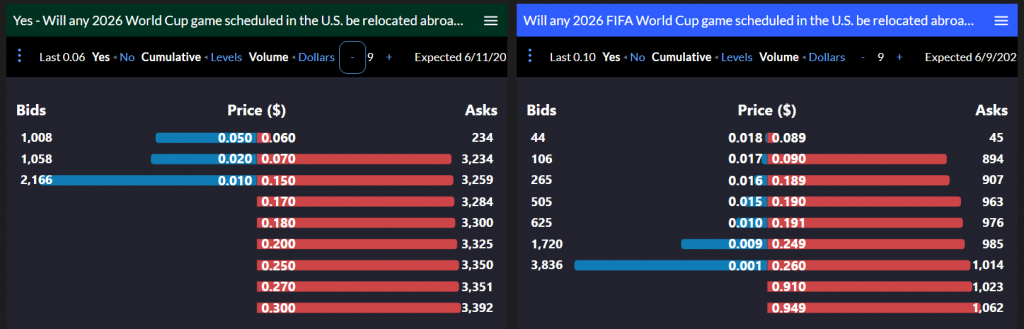
Until that happens, US institutional participants entering event contract markets are working with the wait-until-resolution model by default. Their spreads will be wider, their effective execution costs will be larger, and their overrounds will float higher than what a venue with atomic redemption could offer. Not because the platforms running those markets are doing anything wrong, but because the architectural choice is constrained by what the regulatory framework currently permits.
The architectural choice isn’t going away
The viral post that pulled me into this rabbit hole was about a sports trade. The interesting question underneath it is about how event contracts get priced everywhere they exist. Every trader on these venues, every operator building a platform in this space, every regulator drafting framework for the category, is making a bet about which architecture is the right one—whether they know it or not.
The two prediction markets I was looking at this weekend made theirs visible. Offshore Polymarket runs atomic split-and-merge arbitrage and gets tight pricing pegged near fair value. Kalshi and Polymarket US run traditional clearinghouse architecture by regulatory necessity. Atomic split-and-merge isn’t permitted on a CFTC-regulated DCM, so the architecture and the US-regulated profile come together as a single package.
The architectural choice isn’t going away. It’s going to keep showing up across the legitimate finance applications of event contracts that are coming online over the next few years. The participants who understand the choice will be better positioned than the ones who treat displayed prices as equivalent across venues. And the regulatory framework that emerges for US event contracts—whether it stays where it is or evolves to accommodate atomic redemption architectures—will determine whether US institutional participants ever access the pricing efficiency that’s currently sitting offshore.
