

But they’re great for entertainment value, if hopelessly losing money entertains you.
On CME’s second-quarter earnings call in July, Terry Duffy said of prediction markets: “I think a lot of these contracts are susceptible to manipulation when they list some of these small parlays and things of that nature, and those are not markets. Those are gambling.”
He didn’t expand on that, and I think most people took it as an offhand comment that parlays (“combos”) are longshots with terrible expected value. But I don’t think it’s that simple. Some people call far out-of-the-money options gambling and, depending on motivation, they have a point. The difference is that any investor can easily understand the relationship between what an option costs and what it pays. Parlays are investor-unfriendly at best, and at worst the deck is stacked in ways the buyer can’t see.
We do have some data. A July preprint looked at 23 million Kalshi moneyline trades and found single contracts priced about right. If you bought in at 70%, you won about 70% of the time. However, seemingly uncorrelated parlays (like a basket of moneylines on different games) consistently had a lower percentage of hitting relative to the purchase price.
This implies that the sum of all market forces drives those single legs towards a fair equilibrium price, whereas the various mechanics at play for parlay traders were overpaying for their eventual return. In other words, if you bought a parlay for two uncorrelated moneylines priced independently at 70% each, you’d assume the fair price of their parlay should be 70% x 70% = 49%. But the data shows that traders are taking offers at 50% or more often enough for the win rate to be notably worse.
There are a lot of factors that come into play here, so let’s walk through some of the key ones.
It’s not a sportsbook, but it’s also not exactly the exchange you’ve been promised
Kalshi is a real exchange with real order books. Parlays don’t use them. Of the combo markets that are open and have actually traded, I found resting depth on fewer than one percent—and never on both sides at once.
The order book is empty
What happens instead is that you request a quote for the parlay you want, and anyone can make you an offer. In practice it’s a very small number of participants who actually respond. It’s nontrivial to quote these because you need to have precise views on event probabilities as well as their interdependencies to provide the mandatory two-sided quote. Plus, it’s all privately transmitted between the requester and the maker. Nobody ever sees the quotes that weren’t accepted, so that whole dataset is lost to the ether and can’t be used for price improvement.
The clock is ticking
And on top of it all, the lifetime of a parlay RFQ is seconds long. That means the maker side needs to be completely automated, so that rules out the vast majority of participants. Further, that ticking clock puts a lot of pressure on the taker to accept the offer before it expires. While it’s generally not a big deal to decline the quote and request a new one, there’s clear psychological pressure to avoid the risk of the quote getting worse. In other words, there’s really no time to seriously evaluate the odds and everyone knows it.
Take it or leave it
Since nothing rests on the combo book, you can’t work an order. There’s no bid/ask/last movement to analyze, and there’s no way to inch from your ideal price towards your bottom line. Price improvement is one of the most basic skills any investor learns early on, but there’s no way to apply it here since you don’t actually participate in the quoting process.
And then there are the fees
Another critical aspect of the parlay model is that users are always takers, which means that they pay taker fees. At 50 cents, the fee is 3.5% of the invested capital. But parlay odds tend to be longer. When I pulled every Kalshi combo market carrying volume—5,126 markets, 3.9 million contracts—the median trade was 10 cents, where the fee runs 6.3%. That’s $6.30 for every $100 traded on a trade you’re almost surely going to lose.
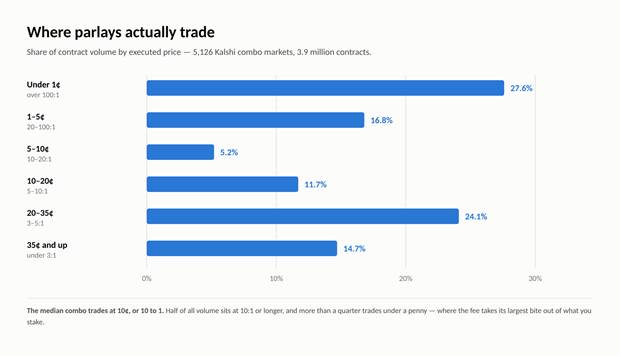
Where combo volume actually sits. Half of it is at 10 to 1 or longer, and more than a quarter trades under a penny.
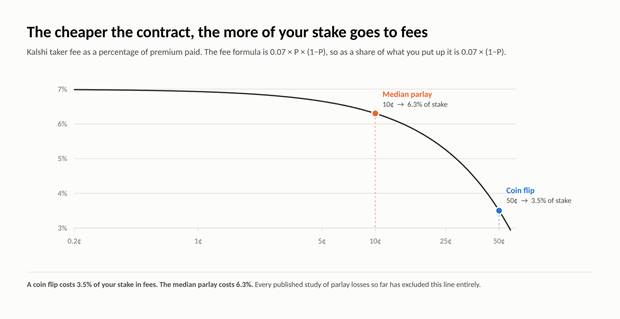
The fee as a share of what you stake rises as the contract gets cheaper.
What’s even worse is that every published study of parlay pricing I found seems to exclude fees from their analysis. The most cited one says so outright: “All reported prices are contract execution prices and exclude exchange fees.” Bloomberg’s $294 million combo loss figure carries “excluding fees” in the text. Citizens puts prediction market parlay returns at -18% against -12% on sportsbook parlays, without saying whether that’s gross or net. Just imagine how much worse everyone is actually doing once you factor in the exchange tax.
The quote data is too opaque
Option traders often trade multileg orders. There are a variety of reasons for this, but the key relevance here is that when a multileg order fills, there is a chain of data reporting that updates the last price, volume, and open interest for each of the contracts involved. It’s easy and logical to derive what a given leg’s contribution to the net price was based on the side and ratio. That data is valuable to all participants in making informed trading decisions.
While it may seem tempting to assume the same of parlays, it doesn’t work that way. Parlays are treated as entirely unique contracts and there is no data reporting of their constituent markets. As a result, there could theoretically be a market that millions of contracts are dependent on that never prints a price, volume, or open interest because it was always part of a parlay.
Obviously, market makers quoting them are basing their net prices on specific probabilities, but they’re allowed to keep those numbers to themselves. Part of this could arguably be to protect their internal models. While it’s easy to calculate the odds of independent events happening, there’s an additional layer of dependency data required to accurately quote dependent events in a parlay.
For example, consider an NFL matchup where the Seahawks were favored at 70% and the odds of them scoring over 21.5 points were 70%. If these were independent events, then the parlay odds should be 49%. However, the two events are likely correlated in that the Seahawks are more likely than 70% to win if they score over 21.5 points, so the parlay pricing would be higher, such as 60%. If it was guaranteed that the Seahawks would win if they scored over 21.5 points (like if it were a playoff game tied at 21 in 2OT) then the parlay odds would be 70%—at that point the two legs are the same event wearing different names.
Past two legs, the correlation is unknowable
In the Seahawks example above, the correlation was extractible from a parlay price through simple arithmetic. However, once you get to three or more legs it becomes impossible without more information. Suppose we added in a third leg where Seahawks QB Sam Darnold threw 2 touchdowns. This would surely be positively correlated with both the points and moneyline markets, but how much?
The reality is that it’s not practical to extract this data. Even if you had all the market prices and all the pairs as parlays, you’d still have a hard time being precise about how a given participant would price the three-leg parlay. And it gets even more complicated as the leg count grows.
In defense of makers
Nobody designed this to harvest anyone. Combo makers face real adverse selection and a real capital floor. Every position is fully collateralized with no netting against the legs, so the markup may be compensation rather than extraction. Kalshi pays makers to quote combos rather than taxing them, and several venues are subsidizing combo liquidity at once. In other words, this is an industry-wide structure rather than one venue’s scheme. Kalshi charges a pure commission with no house edge buried in the price, which compares favorably to a sportsbook, where compiled state filings put parlay hold near 20% against roughly 6% on straight bets. And a fair price on a parlay is still negative sum after costs, as is true of essentially every retail derivative.
In listed options we could settle this pretty easily. There’s plenty of literature decomposing a spread into inventory cost, adverse selection, and order processing, and it works because quotes are published and legs print. You can’t do the same here. The buyer can’t tell whether they’re paying for the maker’s real risk or for their own naivety, and neither can anyone else with the full tape in front of them.
Summing it up
Prediction market users are getting slaughtered in parlays and it shouldn’t be a surprise. And it isn’t just the odds. It’s that the price is formed in a private auction with no book, taken rather than worked, off legs that never print, under a dependence assumption nobody publishes, at a fee rate that rises as the contract gets cheaper, and without the data we need to improve the process.
Some of these can’t be easily fixed, but there’s one big step we could take today: publish the RFQ quotes. Delay and anonymize them so they’re not useful as weapons, but share them so the data is out there. It would be a great first step from “parlay gambler” to “combo trader”. What else could exchanges do to support the people trading these?
